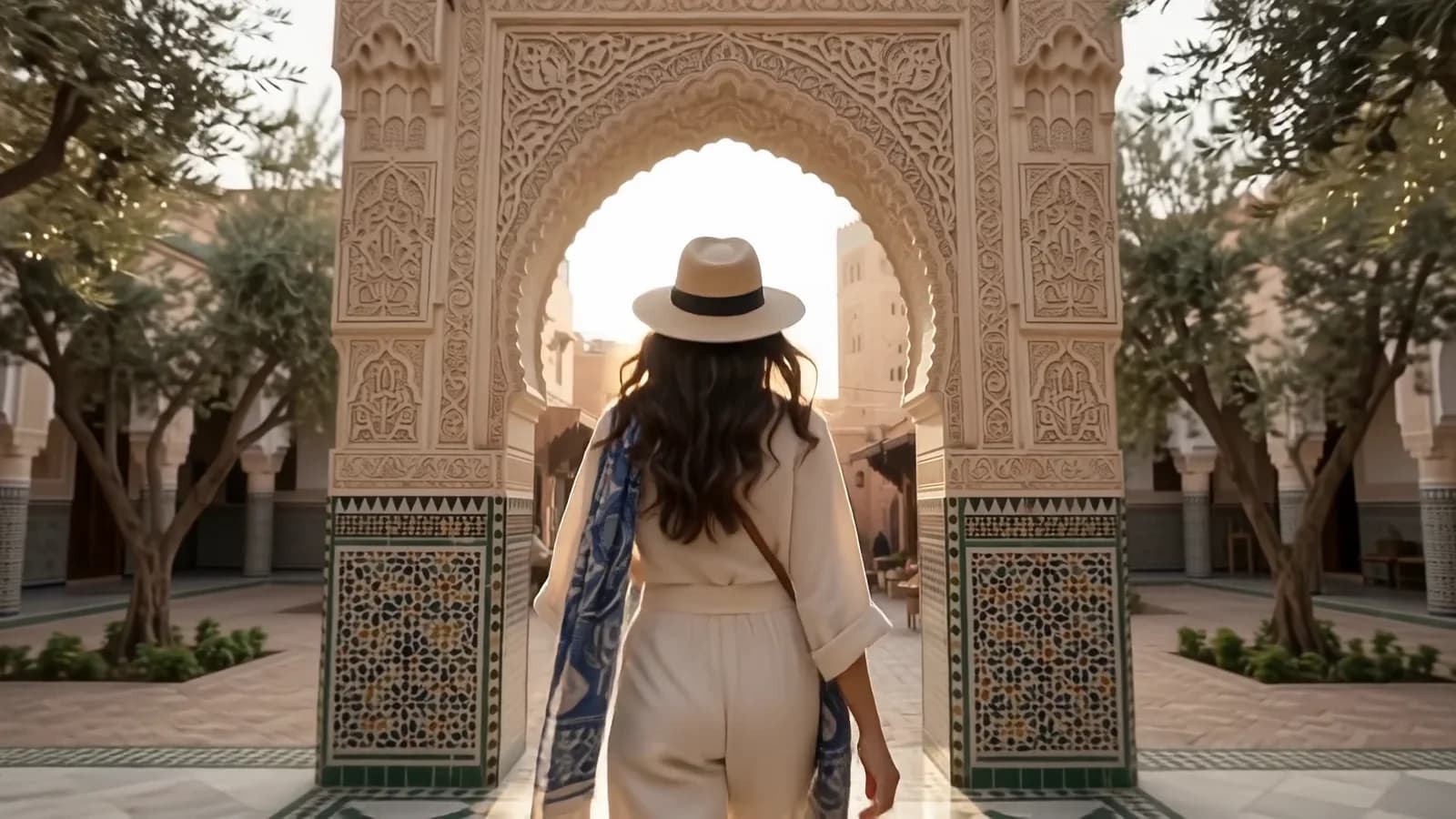
Atlantic coast · a walled port
Essaouira travel guide: the port on the trade wind
Essaouira is a walled port on Morocco’s Atlantic coast, west of Marrakech. Its 18th-century medina is a UNESCO World Heritage site, and blue boats still land fish at the port below the walls.
A walled port on the Atlantic
Essaouira is a fortified port on Morocco’s Atlantic coast, west of Marrakech. Sultan Sidi Mohammed ben Abdallah had it built in the 1760s as a royal port for trade with Europe, with a French engineer, Théodore Cornut, drawing the plan.
The walls are often called Portuguese. The Portuguese did hold a fort here in the early 1500s, but the ramparts you walk today are Moroccan work of the 18th century. UNESCO lists the medina as a World Heritage site.
Europeans knew the town as Mogador. Most days a trade wind, the alizé, blows in off the sea, and it brings windsurfers and kitesurfers to the bay.
Moulay Hassan Square and the port gate
The open square between the medina and the harbour, lined with café terraces. The gate to the port opens off it.
The medina and its souks
The grid of lanes inside the walls, laid out in the 1760s. Markets for spices, grain and fish sit near its centre; most riads are in the side lanes.
The Skala and the woodworkers
The sea rampart on the north-west side. Woodworkers have their workshops in the vaulted rooms under it.
The Mellah
The former Jewish quarter in the north of the medina. Bayt Dakira, a heritage house on the town’s Jewish history, and a restored synagogue are here.
The beach and the new town
South of the walls: the long beach, the promenade and newer hotels, with the medina a walk away along the sand.
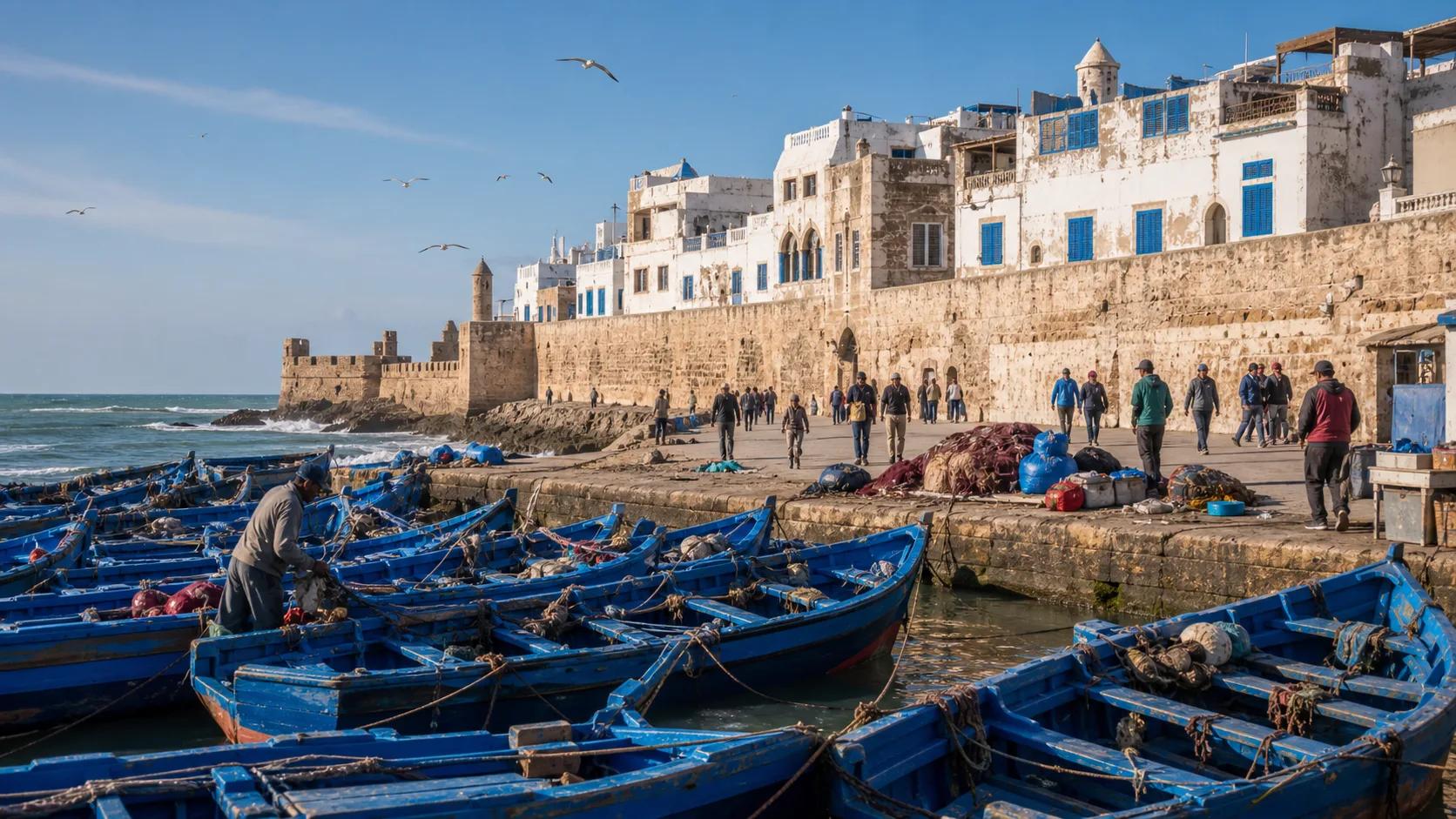
The port, first thing
The blue boats come in through the harbour mouth below the Skala du Port. Nets dry on the quay, gulls work the catch, and the grills by the port gate cook fish to order. Go in the morning, before the town fills.
Illustration · the quay below the walls, with nets drying on the stones
What to see in Essaouira
The sights sit close together inside and along the walls. A slow day on foot covers them; a local private guide gives them their history. Opening days and times change, and we confirm them for your dates.
Skala de la Ville
The rampart walk along the sea, with bronze cannons on the parapet and the Atlantic breaking on the rocks below.
Skala du Port
The bastion at the harbour mouth. It looks back across the boats to the medina, and out to the Mogador islands.
The fishing port
Blue boats, nets on the quay and the morning catch. Small grills near the gate cook fish to order.
The Mogador islands
Offshore, a protected nature reserve. In antiquity a purple dye was made here from sea snails.
Sidi Mohammed ben Abdallah Museum
The town museum, in an old house in the medina: musical instruments, jewellery, costume and woodwork of the region.
Bab Marrakech and Bab Doukkala
Two gates of the 18th-century walls: Bab Marrakech faces the road inland, Bab Doukkala opens to the north beside the Mellah.
The full list, with more to do on the beach and beyond: things to do in Essaouira.
Thuya marquetry and the souks
Essaouira’s own craft is inlaid thuya wood. The workshops sit in the vaulted rooms under the Skala de la Ville, where you can watch a piece being made before you buy it.
Burl
The wood is thuya, a conifer of the hills around Essaouira. The prized part is the burl at the root, swirled like smoke.
Inlay
Lighter woods such as lemonwood, darker ebony, mother-of-pearl or fine metal wire are cut and set into the burl in patterns.
Finish
Sanded and polished, the wood keeps its scent. Boxes, trays, chess boards and small furniture are the usual pieces.
What else the souks sell
- Thuya boxes, trays and chess boards from the workshops under the ramparts
- Argan oil and amlou, from the argan country inland
- Silver jewellery and woven goods in the medina’s main streets
- Paintings by local artists, in the town’s galleries
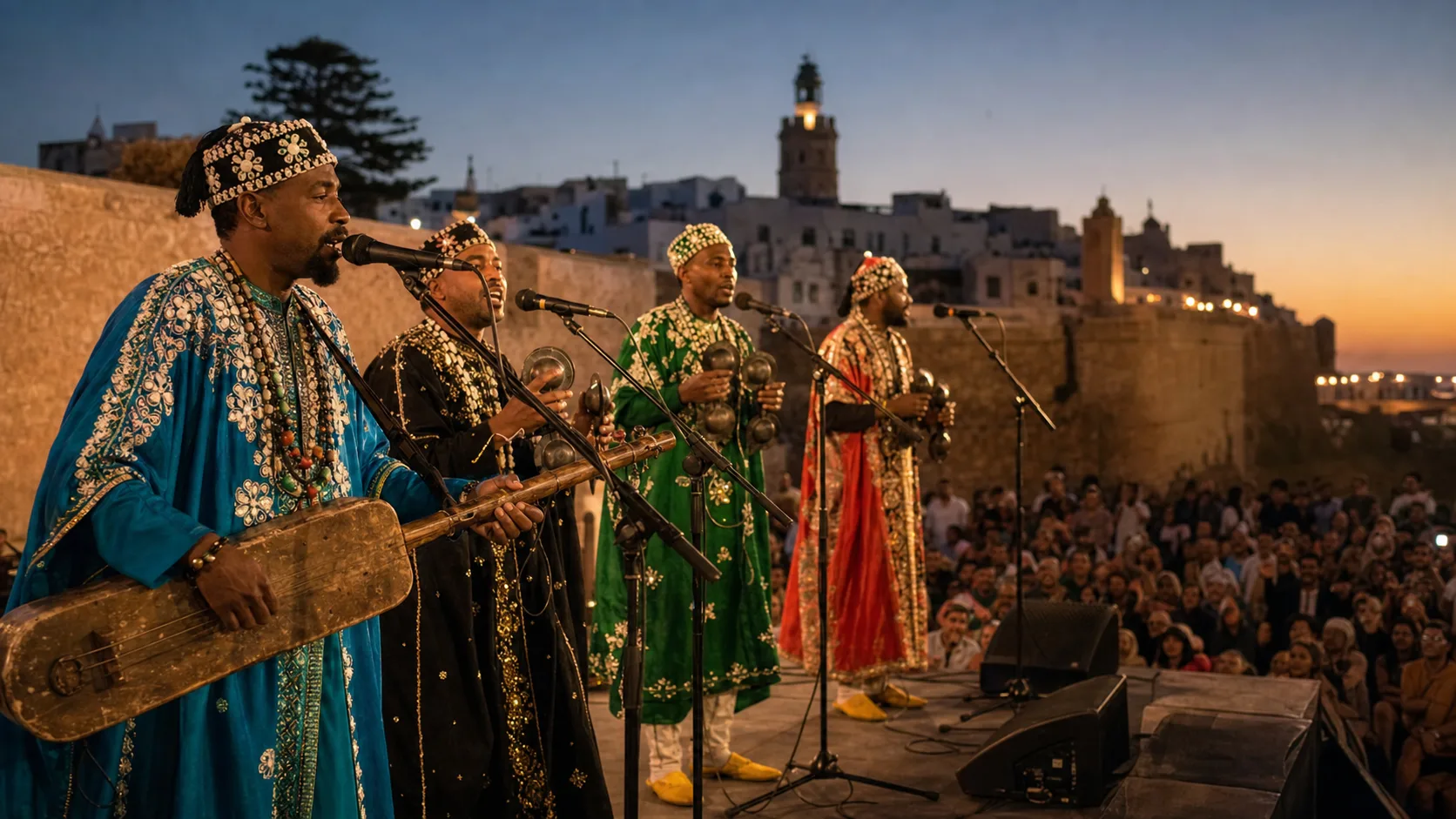
Illustration · Gnawa musicians on a stage below the walls at dusk
Gnawa, the sound of the town
Gnawa music came to Morocco with people brought from sub-Saharan Africa. It belongs to the lila, a night-long ceremony of healing and trance led by a master musician, the maâlem.
Listen for the guembri, a three-string bass lute, under the iron castanets called qraqeb. UNESCO added Gnawa to its list of the Intangible Cultural Heritage of Humanity in 2019.
Essaouira hosts the Gnaoua and World Music Festival each year. Its dates change from year to year, so we confirm them for your trip.
Day trips from Essaouira
The coast runs south to quiet beaches and north to open, windy bays; inland lies the argan country. Your driver-guide takes you there and back.
Sidi Kaouki
South along the coast
A small surf village with a long beach and a white marabout on the shore. Quieter than town, and good for a long beach walk or a ride on the sand.
Diabat
Across the river, south of the beach
A village south of the beach, near Borj El Berod, a ruined fort standing in the surf. Jimi Hendrix visited the area in 1969, and local legend has grown around the visit.
The argan country
Inland, on the Marrakech road
Argan trees grow across this region, which UNESCO lists as a biosphere reserve. Women’s cooperatives crack the nuts and press the oil.
Moulay Bouzerktoune
North along the coast
An open bay where the trade wind blows hard and clean. Wind-sport riders go there; others go to watch.
Two to four days on the coast leaves room for the town and one or two of these. Ready-made ideas: Essaouira tours, day trips from Essaouira, or Essaouira as a day trip from Marrakech.
When to go to Essaouira
Go from April to June and September to October. The trade wind keeps Essaouira mild all year: average highs run from 18°C in January to 23°C in September, while inland Marrakech is far hotter in summer.
June to August is the busiest time. Winter is quiet and brings most of the year’s rain days. The sea is warmest in September, at about 21°C, and cool for swimming the rest of the year.
Our best months, from the same climate data
| Month | High | Low | Sea |
|---|---|---|---|
| January | 18 | 11 | 17 |
| February | 19 | 12 | 16 |
| March | 19 | 13 | 16 |
| April | 20 | 14 | 17 |
| May | 21 | 16 | 18 |
| June | 21 | 17 | 19 |
| July | 22 | 18 | 19 |
| August | 22 | 18 | 20 |
| September | 23 | 18 | 21 |
| October | 22 | 17 | 20 |
| November | 21 | 14 | 19 |
| December | 19 | 13 | 17 |
How many days, and how to get there
How many days in Essaouira
Sleep in town at least once. Essaouira is at its best early in the morning, when the boats come in, and at dusk on the ramparts, and a day trip from Marrakech misses both.
Essaouira fits a week that starts in Marrakech, or a longer trip along the whole coast, like our private Atlantic coast journey.
Getting there and around
- By road from Marrakech: about two and a half to three hours west. There is no train.
- Essaouira has a small airport; most travellers fly into Marrakech.
- Inside the walls you walk: the medina is compact and largely closed to cars, so drivers stop at the gates.
- On a private trip your driver-guide handles every transfer, and the day trips beyond town.
Manners and safety
- Ask before you photograph people, fishermen at the port included.
- Cover shoulders and knees in the medina; the beach is the place for beachwear.
- Agree a price before a ride, a carriage or a plate at the port grills.
- Bargaining is normal in the souks, fixed prices are normal in cooperatives and galleries.
- The wind is strong and the Atlantic is cold, with currents. Swim where others swim and keep off wet rocks on the sea side of the walls.
- Bring a layer at every time of year: the wind makes evenings cool even in summer.
After you ask for a quote
What you receive when you ask us to plan Essaouira
Your proposal contains
- A day-by-day route, with the driving time between stops
- Stays matched to your style (riads, kasbahs, desert camps or hotels), named so you can look them up
- Which moments are private to you, and which are shared, such as a camp’s dining tent
- An itemised quote: what is included and what is not
- Who is planning your trip, and how to reach them on WhatsApp
- Free, with no obligation to book
Before you pay a deposit, we confirm
- Opening days for the places on your route, including Friday and holiday closures
- Meal stops along the way, and any dietary needs
- Prayer or Shabbat timing, if it matters to you
- Step-free access, wherever you need it
- The vehicle class for your group and your luggage
Every trip is private and priced to your dates, so there is no fixed price list. Ask, and the proposal shows the full cost before anything is booked.
Essaouira questions
How many days do you need in Essaouira?
Two nights is the comfortable minimum. One full day covers the medina, the ramparts and the port; the second leaves time for the beach, Sidi Kaouki or the argan country. One night works when Essaouira is a stop between Marrakech and the coast.
When is the best time to visit Essaouira?
April to June and September to October. Average highs run from 18°C in January to 23°C in September, because the Atlantic trade wind keeps the town cool. The sea is warmest in September, at about 21°C.
Is Essaouira safe for visitors?
Essaouira is a calm town that most visitors find easy to walk. Take the usual medina care: watch your bag in crowds and agree prices first. The real hazards are natural: strong wind, cold water with currents, and wet rocks on the sea side of the walls.
Should we stay in the medina or the new town?
Stay inside the medina walls if you want to walk everywhere: the riads are in the lanes, and the port, ramparts and souks are minutes apart. Hotels south of the walls, by the beach, suit travellers who want more space and the sea front, with the medina a walk away along the sand.
How do you get from Marrakech to Essaouira?
By road: about two and a half to three hours west of Marrakech. There is no train. On a private trip your driver-guide takes you, door to door. Essaouira also has a small airport, though most travellers fly into Marrakech.
When is the Gnawa festival in Essaouira?
The Gnaoua and World Music Festival is held in Essaouira each year, usually in early summer. The dates change from year to year, so we confirm them for your trip before anything is booked.
What does a private trip with Serenity include?
A private driver-guide, local private guides in the medinas, stays chosen for your trip (riad, kasbah hotel, desert camp or hotel), every reservation made by our team in Casablanca, airport meet-and-greet, a pre-departure briefing and WhatsApp support on +212 701 664 704 during the trip.
How much does a trip to Essaouira cost?
It depends on your dates, the number of nights, who is travelling and the stays you choose, so every trip is quoted to you. The quote is free and you get a reply within 24 hours.
Tell us how long you want by the sea
المغربⵜⴰⴳⵍⴷⵉⵜ ⵏ ⵍⵎⵖⵔⵉⴱThe Kingdom of Morocco