Todra Gorge vs Dades Gorge: Which Morocco Canyon to Visit?
If you're choosing between Todra Gorge and Dades Gorge, here's the short answer: Todra's narrow slot — walls nearly 300 metres high closing to roughly 10 metres — is the more singular image; Dades is the more immersive valley, with a chain of kasbahs, Monkey Fingers rock formations, and one of Morocco's most-photographed switchback roads. They sit roughly 90 kilometres apart on the same overland route to the Sahara. On a trip of a week or more, you can see both without backtracking. If you're truly pressed for time, pick Todra.
That's the practical answer. The longer one matters, because both gorges are dramatically different experiences and choosing the wrong one for your timing or priorities can mean a rushed stop at exactly the wrong moment. Here's how they compare and how to sequence them well.
At a Glance
| Todra Gorge | Dades Gorge | |
|---|---|---|
| Location | Near Tinghir, eastern High Atlas | Near Boumalne Dades, south of Atlas |
| Drive from Marrakech | ~7–8 hours via Ouarzazate | ~5–6 hours via Ouarzazate |
| Distance between them | ~90 km, roughly 1.5h drive | — |
| What's dramatic | Narrow slot, ~300m walls closing to ~10m | Switchback road, Monkey Fingers rocks, kasbah valley |
| Best activity | Walk the slot, rock climbing | Scenic drive, photography, viewpoints |
| Best light | Early morning | Late afternoon / golden hour |
| Crowds | Mid-morning day-trippers from Merzouga | Generally lighter, especially upper gorge |
| Overnight base | Tinghir or at the gorge | Boumalne Dades |
| Note | Drive times are estimates; confirm for your dates | — |

Todra Gorge: The Narrow Slot
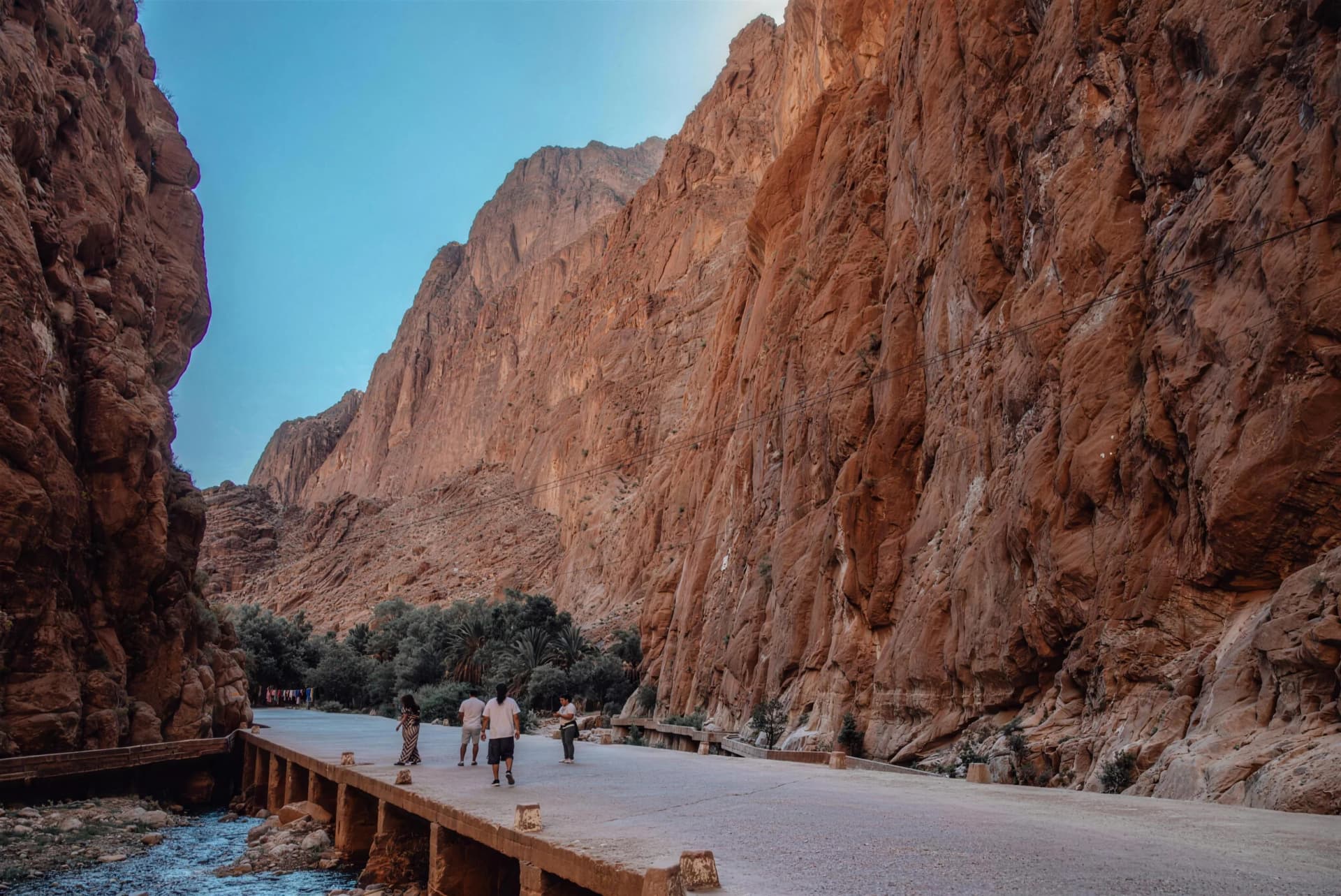
The key fact about Todra is the walls. The gorge begins as a wide, palm-lined river valley north of Tinghir, tightening over several kilometres until it reaches La Grande Falaise — the main slot, where the limestone cliffs on either side rise close to 300 metres and the gap between them shrinks to roughly 10 metres. Standing in the slot and looking straight up, you see a thin ribbon of sky. The river still runs through the floor in a cold, clear stream you can step across. The effect is immediate and vertiginous in a way that photographs only partially capture.
The approach from Tinghir runs through a near-continuous palm oasis, one of the most lush in southern Morocco. Small restaurants and cafés are built directly against the cliff faces at the gorge entrance; there's a car park at the main slot where coaches unload day-trippers from the Merzouga camps. Timing is the main variable: before about 9:30am the gorge is quiet, the light hits the upper walls cleanly, and the river sounds carry without competition. By late morning the coaches arrive and the narrow path through the slot gets busy. Arriving early and staying through mid-morning is the way to do it.
Beyond the spectacle, Todra is a legitimate rock-climbing destination. The walls carry hundreds of bolted routes from beginner-friendly sport climbs to serious multi-pitch routes, and Tinghir has a small infrastructure of guides, gear hire, and accommodation aimed at climbers. If you're not climbing, the core experience is the walk through the slot itself — flat, easy, about 30 minutes round-trip — and a little further into the upper gorge where the cliffs open to dramatic bluffs and Berber villages sit above the tree line.
Dades Gorge: The Dramatic Drive
Dades operates at a different scale and a different pace. The Dades Valley itself — sometimes called the Valley of a Thousand Kasbahs — runs roughly 25 kilometres north from the town of Boumalne Dades, lined with a near-continuous sequence of ochre-coloured kasbahs in varying states of repair. Some are inhabited and patched over centuries of use; others are dissolving back into the earth they were built from. The drive up the valley, even before you reach the gorge, is worth doing.
The gorge proper begins where the road and the Dades River enter the cliffs. The rock here is softer and more varied in colour than Todra's limestone, running from pale ochre to deep rose depending on the light. The Monkey Fingers formations appear roughly halfway up: columns of rounded, pinkish-orange stone worn by erosion into shapes that local guides describe as giant hands reaching toward the sky. In afternoon light, when shadows deepen the contours, the Monkey Fingers are among the most photogenic rock formations in Morocco.
Then, near the top of the accessible paved section, the road starts climbing. It turns into a series of tight hairpin switchbacks cut directly into the cliff face, each turn with a steep drop on one side and a rock wall on the other. The road is well-maintained and manageable in a standard car; it's the view from the corners and from the overlook above the switchbacks that makes it famous. The late afternoon is when this section is most beautiful, the low sun hitting the gorge from the west and turning the whole landscape an intense orange. If you're overnighting in the Dades Valley — at one of the small hotels built into the gorge itself — you get the switchbacks at golden hour and a quiet morning departure the next day.
The Sequencing Truth: You Can Probably See Both
Most comparison guides treat this as a binary decision. In practice, for anyone doing the standard Marrakech-to-Merzouga (Sahara) route, the choice is largely a sequencing question. Dades lies about 90 kilometres west of Todra, connected by a paved road through Kelaa M'Gouna — the Rose Valley, worth a brief stop in May when the rose harvest is on — and through Tinghir's long oasis. The direct drive between the two gorges is about 1.5 hours.
The schedule that works on a private tour: arrive at Dades in the late afternoon on day one, roughly 5–6 hours from Marrakech; walk the lower valley and switchback viewpoint before dinner; overnight in the gorge. Leave Dades the next morning, drive to Todra (1.5 hours), arrive at the slot before 10am to beat the day-trippers, walk the main section; then continue east to Merzouga (a further 3–4 hours via Tinghir and Erfoud). Two gorges, at their best light, no backtracking.
This works within the standard Marrakech-to-Sahara structure. What it does require is either breaking the Marrakech-to-Merzouga journey over two days (which is almost always the right call — the route has too much to rush) or starting from Marrakech very early. A one-day push from Marrakech all the way to Merzouga is possible but leaves little room for anything along the way.

If You Can Only Choose One
When a schedule genuinely forces a choice, pick Todra Gorge.
Not because Dades is lesser — it isn't, and the switchback road is a genuine spectacle. But Todra's narrow slot is rarer. The combination of 300-metre walls, a 10-metre gap, and the cold river on the floor is a landscape type that doesn't have many equivalents. It's more surprising, and more contained: a single walk of 30–60 minutes delivers the full experience. Dades rewards slower travel and lingering; if you're moving quickly, Todra repays a stop more efficiently.
The caveat: if your priority is driving rather than walking — if you're there for the road and the view rather than the canyon itself — Dades has the stronger argument. The switchback photography from the overlook is famous for good reason.
Month-by-Month: When to Visit
Spring (March–May): The best season for both gorges. Mild temperatures, green palm oases, and the rose festival at Kelaa M'Gouna in May (which falls directly on the road between the two gorges). Dades is particularly beautiful in early spring when water flows more strongly through the lower gorge and the rock gardens are green.
Summer (June–August): Hot in the valley floors — midday temperatures can exceed 40°C in July and August — but the gorges themselves retain shade from the walls for much of the morning. Start drives early and finish by noon. The Sahara heat at this time of year is the bigger constraint on the overall itinerary than the gorges themselves.
Autumn (September–November): Similar conditions to spring: warm, reliable, excellent for photography. Slightly lower visitor numbers than the spring peak. One of the best windows for the full Marrakech-to-Merzouga route.
Winter (December–February): The gorges stay accessible in winter — neither requires high-altitude driving — but the Tizi n'Tichka pass between Marrakech and Ouarzazate can close briefly after heavy snowfall in January or February. The pass is usually clear, but confirm road conditions before setting off in the coldest months. Winter light in the gorges is harder and colder; photographers who want dramatic shadows and near-empty locations often prefer it.
How the Gorges Fit the Marrakech–Sahara Route
Both gorges sit on Morocco's Route of a Thousand Kasbahs, the southern overland corridor linking Ouarzazate to the Sahara dunes at Merzouga. It's one of the most varied drives in North Africa, and the gorges are the two main drama spikes on an already extraordinary route.
The typical sequence from Marrakech: cross the Tizi n'Tichka pass (2,260m, paved throughout), arrive in Ouarzazate for lunch, stop at Aït Benhaddou in the late afternoon for the kasbah, push on to Dades for the night. Next morning: Todra, then east toward Merzouga and the Erg Chebbi dunes. That's the shape of it.
On a private tour, your driver handles the mountain pass and navigates the Dades valley road — you're watching the landscape change from Mediterranean scrub to desert varnish over the course of a day's drive. Browse how the gorge stops fit a wider itinerary on our tours page, or build the sequence yourself on our custom tour planner.
FAQ
Which is more impressive, Todra Gorge or Dades Gorge? They impress differently. Todra's narrow slot — walls nearly 300m high narrowing to about 10m — is the more concentrated single image. Dades offers a fuller landscape experience: the kasbah valley, the Monkey Fingers formations, and the famous switchback road. Most travelers who see both say they're glad they didn't skip either.
How far apart are Todra Gorge and Dades Gorge? About 90 kilometres by road, roughly a 1.5-hour drive via Kelaa M'Gouna and Tinghir.
Can I visit both gorges in one day? Possible, but tight. Combining both gorge walks with the drive between them in a single day leaves little time for lingering. Better to overnight in the Dades Valley, do Todra the next morning, and continue to Merzouga from there.
When should I arrive at Todra Gorge to avoid the crowds? Before 9:30–10am. Day-trippers arrive from Merzouga and Tinghir mid-morning, so an early arrival gives you the slot at its quietest and in the best light.
Do I need a 4x4 for either gorge? No. Both main gorge areas are reached by paved roads accessible in a standard car. A 4x4 opens optional off-piste routes beyond the main areas, but neither site requires it.
Are the gorges walkable? Todra's main slot is an easy 30–60 minute walk on flat ground. The Dades switchback section is a drive to the viewpoint, with short walks from the overlooks. Neither requires serious hiking.
Not sure how to fit both gorges into your route? We plan this drive regularly — tell us your pace and priorities on our custom tour page and we'll build the sequence around what you actually want to see.
Tags
Share this article
Written by
Serenity Morocco editorial team
Serenity Morocco Tours
Our in-house editors and Morocco travel designers research, write, and fact-check every guide — drawing on first-hand local knowledge across the country's cities, desert, mountains, and coast.
Get Morocco Travel Insights