When was Morocco founded, and when did the Arabs arrive?
The short answer
Our team's answerThere is no single founding date. Historians usually date the first Moroccan state to 788, when Idris I founded the Idrisid dynasty near Volubilis. Arab armies first reached Morocco in the 680s. The Alaouite dynasty, still reigning, took power in the 1660s, and Morocco regained independence in 1956.
Serenity Morocco Expert Team
Travel Designer · Staff · November 2026
Question
The full answer
A common question when planning a trip to Morocco, answered honestly by our travel designers.
The answer depends on what “founded” means. People lived in what is now Morocco long before any kingdom with that name, and the Amazigh (Berber) peoples were here before the Romans or the Arabs. From about the 3rd century BCE the north of the country belonged to the Amazigh kingdom of Mauretania. Rome annexed it in the 40s CE and governed it as the province of Mauretania Tingitana, with its capital at Tingis, today’s Tangier, and Volubilis, near Meknes, as a major administrative centre. The ruins you can visit at Volubilis come from that period.
The Arabs arrived with the Muslim conquest of North Africa, which began in the middle of the 7th century and was completed in the early 8th. According to later Arabic chronicles, the general Uqba ibn Nafi led a campaign during his second governorship, which began in 681, that took Ceuta and Tangier and reached the Atlantic; he was killed in 683. Islam spread over the following decades. The people of Morocco today descend from Amazigh, Arab and Andalusian ancestors, and the state does not record ethnicity, partly because the line between Arab and Amazigh is so hard to draw.
The date most often given for the founding of Morocco as a state is 788, when the Idrisid dynasty began. Idris I, a descendant of the Prophet Muhammad, was taken in at Volubilis by the Awraba, an Amazigh tribe, who made him their imam. In 789 he founded a settlement that became Fes, and in 809 his son Idris II moved the seat of government there. Historians describe the Idrisids as the founders of the first Moroccan state, and the national story treats them as the start of an unbroken monarchy.
Several dynasties followed, among them the Almoravids, Almohads, Marinids and Saadians, and Marrakech served as capital under the Almoravids, Almohads and Saadians. That is where the country’s English name comes from: “Morocco” derives from Marrakech, through the Spanish “Marruecos”. The current royal family, the Alaouites, rose in the Tafilalt oasis, where Moulay al-Sharif was declared sultan in 1631. His son al-Rashid was recognised as sultan in 1664 and took Fes in 1666, which is why the dynasty is usually dated to the 1660s. King Mohammed VI is the current monarch.
The modern state dates from the end of colonial rule. Under the Treaty of Fes, signed on 30 March 1912, Morocco became a French protectorate, with Spain holding zones in the north and south. Sultan Mohammed V returned from exile on 16 November 1955 and declared independence two days later, which is why 18 November is Independence Day, a public holiday. France ended its protectorate on 2 March 1956 and Spain on 7 April 1956, and Tangier, an international zone, was reintegrated on 29 October 1956.
For travellers, the easiest way to see this timeline is a day around Meknes: Roman Volubilis, the hill town of Moulay Idriss built around the tomb of Idris I, and Fes, the city the Idrisids founded, lie within about an hour and a half’s drive of each other.
- history
- idrisids
- alaouite dynasty
- independence
- volubilis
- timeline
Helpful links
Serenity Morocco Expert Team — Travel Designers, Serenity Morocco Tours. Answered November 2026.
More questions on this
Who founded Morocco?
Idris I, who founded the Idrisid dynasty in 788 at Volubilis. Historians treat the Idrisids as the first Moroccan state.
When did Morocco become independent?
France ended its protectorate on 2 March 1956 and Spain on 7 April 1956. Independence Day, 18 November, marks Mohammed V’s declaration in 1955.
When did the Arabs come to Morocco?
Arab armies reached Morocco in the 680s under Uqba ibn Nafi, and the Muslim conquest of the region was completed in the early 8th century.
After you ask for a quote
What you get within 24 hours
Your proposal contains
- A day-by-day route, with the driving time between stops
- Stays matched to your style (riads, kasbahs, desert camps or hotels), named so you can look them up
- Which moments are private to you, and which are shared, such as a camp’s dining tent
- An itemised quote: what is included and what is not
- Who is planning your trip, and how to reach them on WhatsApp
- Free, with no obligation to book
Before you pay a deposit, we confirm
- Opening days for the places on your route, including Friday and holiday closures
- Meal stops along the way, and any dietary needs
- Prayer or Shabbat timing, if it matters to you
- Step-free access, wherever you need it
- The vehicle class for your group and your luggage
Every trip is private and priced to your dates, so there is no fixed price list. Ask, and the proposal shows the full cost before anything is booked.
From the answer to the trip
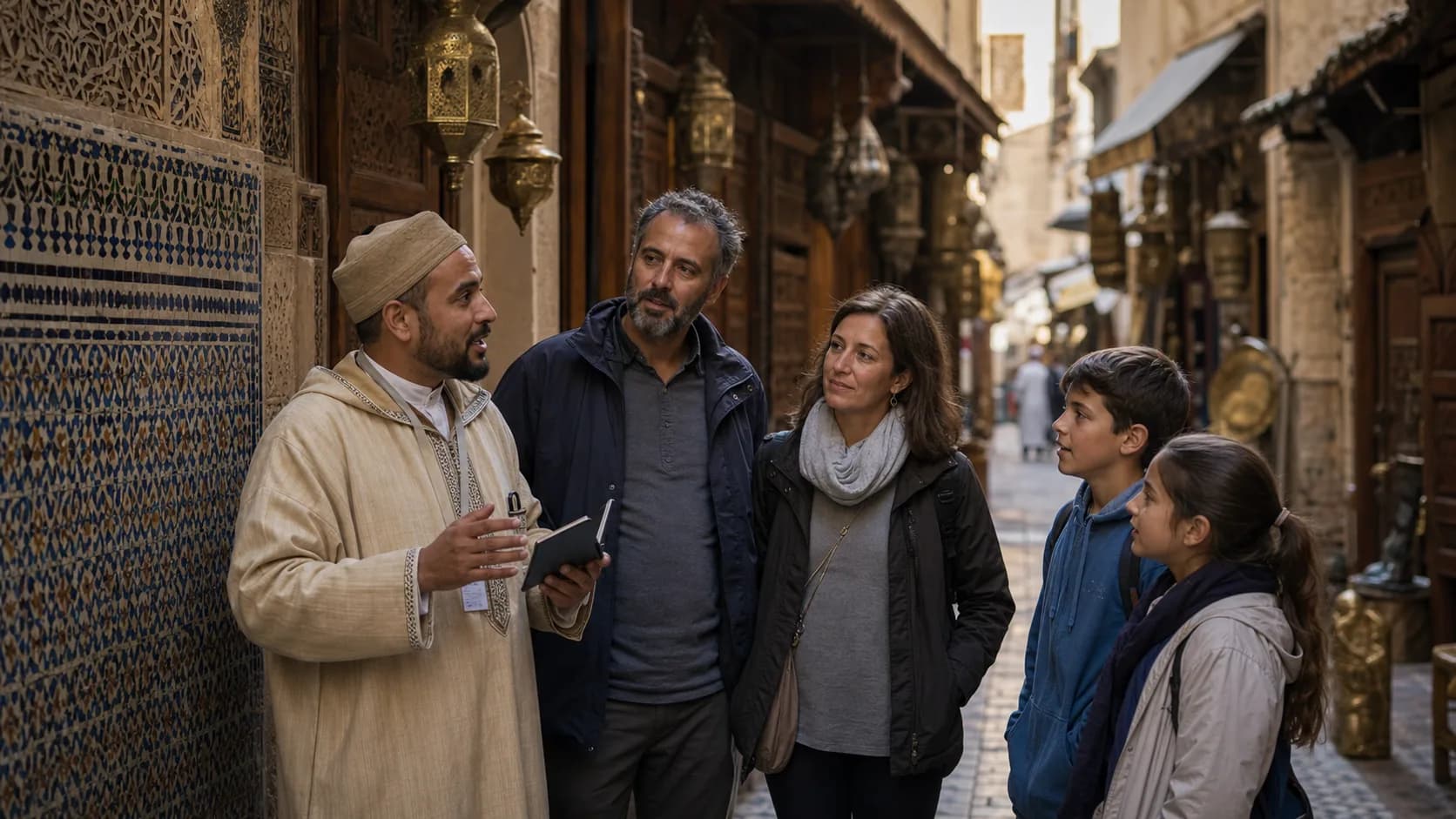
Fes, with a guide who knows the lanes
Fes el-Bali has more than nine thousand lanes. A private guide takes you to the tanneries, madrasas and workshops, and back out again.
- 5 days · FesFes Culinary & Craft Immersion
- 9 days · Central MoroccoImperial Cities Journey
- 10 days · Central MoroccoImperial Cities Grand Tour

A planner in Casablanca replies with a day-by-day route and a quote within 24 hours.
Ask a follow-up question
Something this answer does not cover? Send us your question and our travel designers will read it.