Why does Agadir look so modern? What happened in 1960?

The short answer
Our team's answerBecause the old city was destroyed. A shallow earthquake struck Agadir on 29 February 1960 and killed an estimated 12,000 to 15,000 people, about a third of the population. The city was rebuilt slightly to the south on a modern plan with mandatory seismic standards, which is why it has wide avenues and no old medina.
Serenity Morocco Expert Team
Travel Designer · Staff · October 2026
Question
The full answer
A common question when planning a trip to Morocco, answered honestly by our travel designers.
Agadir surprises visitors who expect another Fes or Marrakech. There is no walled medina, no maze of old lanes and very few buildings older than the 1960s. The reason is the earthquake of 29 February 1960, which struck late at night on the third day of Ramadan. Its magnitude was moderate, but its focus was very shallow, about 15 km down, and close to the city, so the shaking at the surface was extreme.
The loss was enormous for a city of its size. Sources estimate that between 12,000 and 15,000 people died, about a third of Agadir's population at the time, with some 12,000 injured and at least 35,000 left homeless. The districts hit hardest were Founty, the Kasbah on its hill, Yachech and the old quarter of Talborjt. Engineers later pointed to the shallow focus and to buildings put up quickly in the decade before, without any thought for earthquakes, as the reasons the damage was so severe.
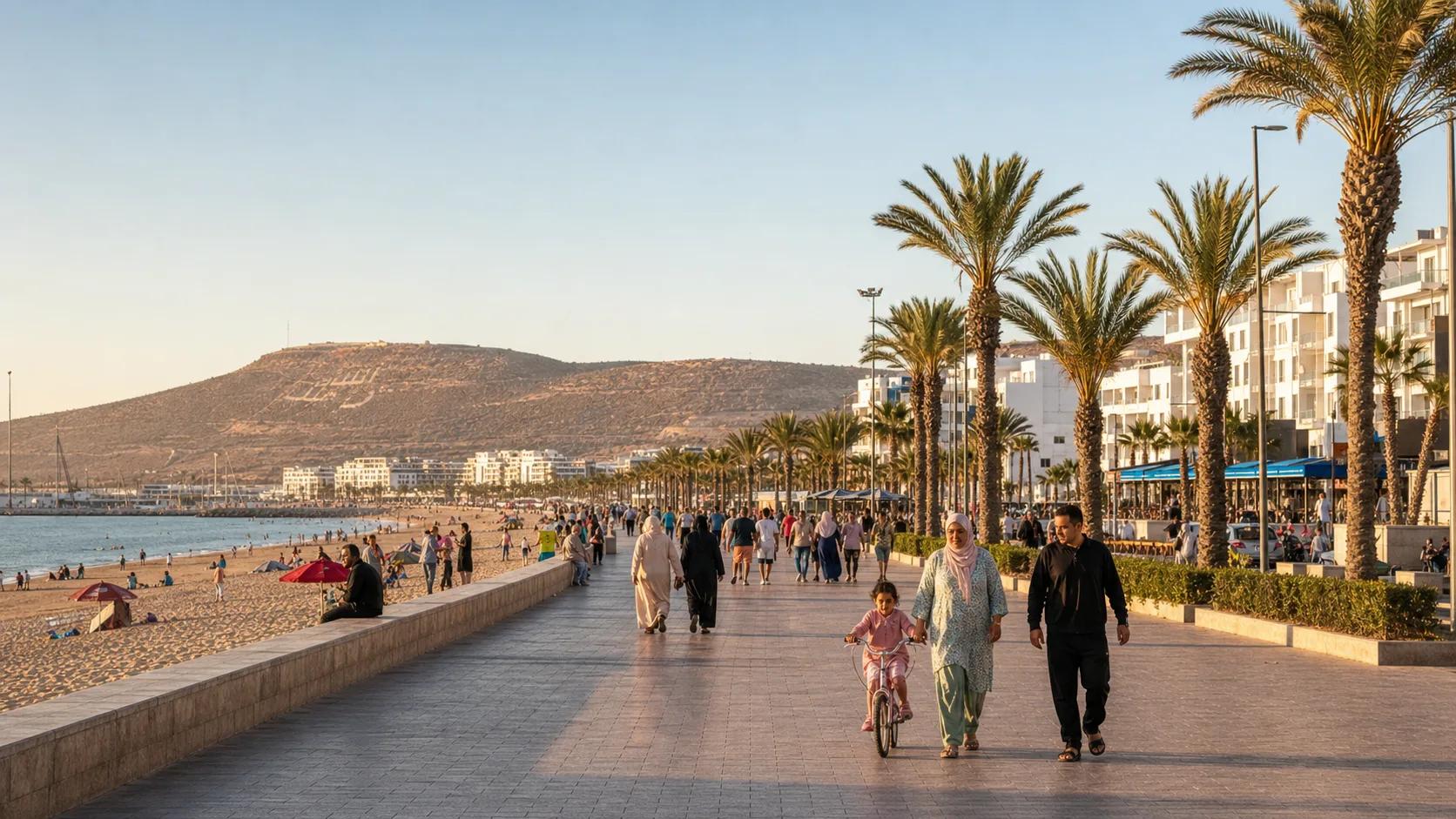
Rather than rebuild on the ruins, Morocco created a dedicated reconstruction authority in June 1960 and drew up a new plan. About 250 hectares of the most unstable ground, including the Kasbah ridge, Founty, Old Talborjt and Yachech, were declared unbuildable. The new city was laid out about 1.6 km further south on a grid, with buildings on raised ground, parks in the low-lying hollows, and seismic standards that every new building had to meet.
The architects behind much of the new Agadir belonged to a group of Moroccan modernists, including Jean-François Zevaco and Elie Azagury, with Le Corbusier consulted on the plan. That is why the centre has flat roofs, concrete, open plazas and long straight avenues: Agadir is a showcase of 1960s modernist town planning, and architecture enthusiasts come specifically to see it.
You can still trace the earthquake in the city today. The hill of Agadir Oufella, where the old kasbah stood, keeps its restored outer wall and a wide view over the bay. In New Talborjt, the Olhão garden, named after Agadir's twin town in Portugal, holds a small memorial museum about the disaster and the old city. Old Talborjt itself was never rebuilt and remains open ground. Visiting these places is a quiet way to understand why the Agadir you see is so new, and it is worth approaching them with the respect due to a city that lost so many of its people in a single night.
- agadir
- 1960 earthquake
- history
- architecture
- modernism
- talborjt
- oufella
Helpful links
Serenity Morocco Expert Team — Travel Designers, Serenity Morocco Tours. Answered October 2026.
More questions on this
When was the Agadir earthquake?
On 29 February 1960, late at night, on the third day of Ramadan.
How many people died?
Sources estimate between 12,000 and 15,000 people, about a third of the city at the time.
Where can I learn about it in Agadir?
The Olhão garden in New Talborjt holds a small memorial museum, and the hill of Agadir Oufella shows where the old kasbah stood. Check opening times locally.
After you ask for a quote
What you get within 24 hours
Your proposal contains
- A day-by-day route, with the driving time between stops
- Stays matched to your style (riads, kasbahs, desert camps or hotels), named so you can look them up
- Which moments are private to you, and which are shared, such as a camp’s dining tent
- An itemised quote: what is included and what is not
- Who is planning your trip, and how to reach them on WhatsApp
- Free, with no obligation to book
Before you pay a deposit, we confirm
- Opening days for the places on your route, including Friday and holiday closures
- Meal stops along the way, and any dietary needs
- Prayer or Shabbat timing, if it matters to you
- Step-free access, wherever you need it
- The vehicle class for your group and your luggage
Every trip is private and priced to your dates, so there is no fixed price list. Ask, and the proposal shows the full cost before anything is booked.
From the answer to the trip
The Atlantic coast, from Agadir to Essaouira
Agadir’s long beach, the surf villages to the north and the blue port of Essaouira: a private coast trip with your own driver-guide, or a day out from Marrakech.
- 7 days · Agadir CoastMoroccan Surf & Yoga Escape
- 6 days · Atlantic CoastCoastal Morocco Escape
- 4 days · Atlantic CoastCoastal Essaouira & Beach Retreat
A planner in Casablanca replies with a day-by-day route and a quote within 24 hours.
Ask a follow-up question
Something this answer does not cover? Send us your question and our travel designers will read it.