Kitesurfing in Morocco centres on Dakhla, a lagoon of about 40 km of flat, shallow water in the far south, and Essaouira, the Atlantic medina town where the Alizée trade wind blows hardest from April to August. Good days bring around 20 to 35 knots from the north-northeast. Sidi Kaouki, Oualidia, Moulay Bousselham and El Haouzia cover the lighter and quieter end. Check a live forecast before you fix dates.
Dakhla is the only spot that rides all year. Everywhere else the season is spring into early autumn, when the trade wind settles over the Atlantic coast.
Most reliable In seasonWind varies year to year: check Windguru, Windfinder or Windy before you book.
The kite spots
Where to kite in Morocco, lagoon to city beach
Dakhla
Far south, on the Atlantic
Season
Year-round; most reliable April to October
Wind
20–35 kn on good days
Direction
NNE, side-onshore across the lagoon
Water
Flat lagoon about 40 km long; ocean waves on the peninsula
Level
All levels
A sand peninsula holds back the Atlantic and leaves a long lagoon behind it: shallow, nearly current-free, and in the learning zone often knee to waist deep. The trade wind funnels between the peninsula and the coast, builds from late morning and eases after sunset. Water sits around 20 to 24°C most of the year. On the ocean side, exposed beaches take Atlantic swell for wave riders.
Where kiters stay
Kite camps on the lagoon bundle rooms, meals, gear, lessons and airport transfers; guesthouses in town suit independent kiters.
Getting there
Fly to Dakhla (VIL) from Casablanca or Agadir. The road from Agadir takes about 14 hours, so most kiters fly.
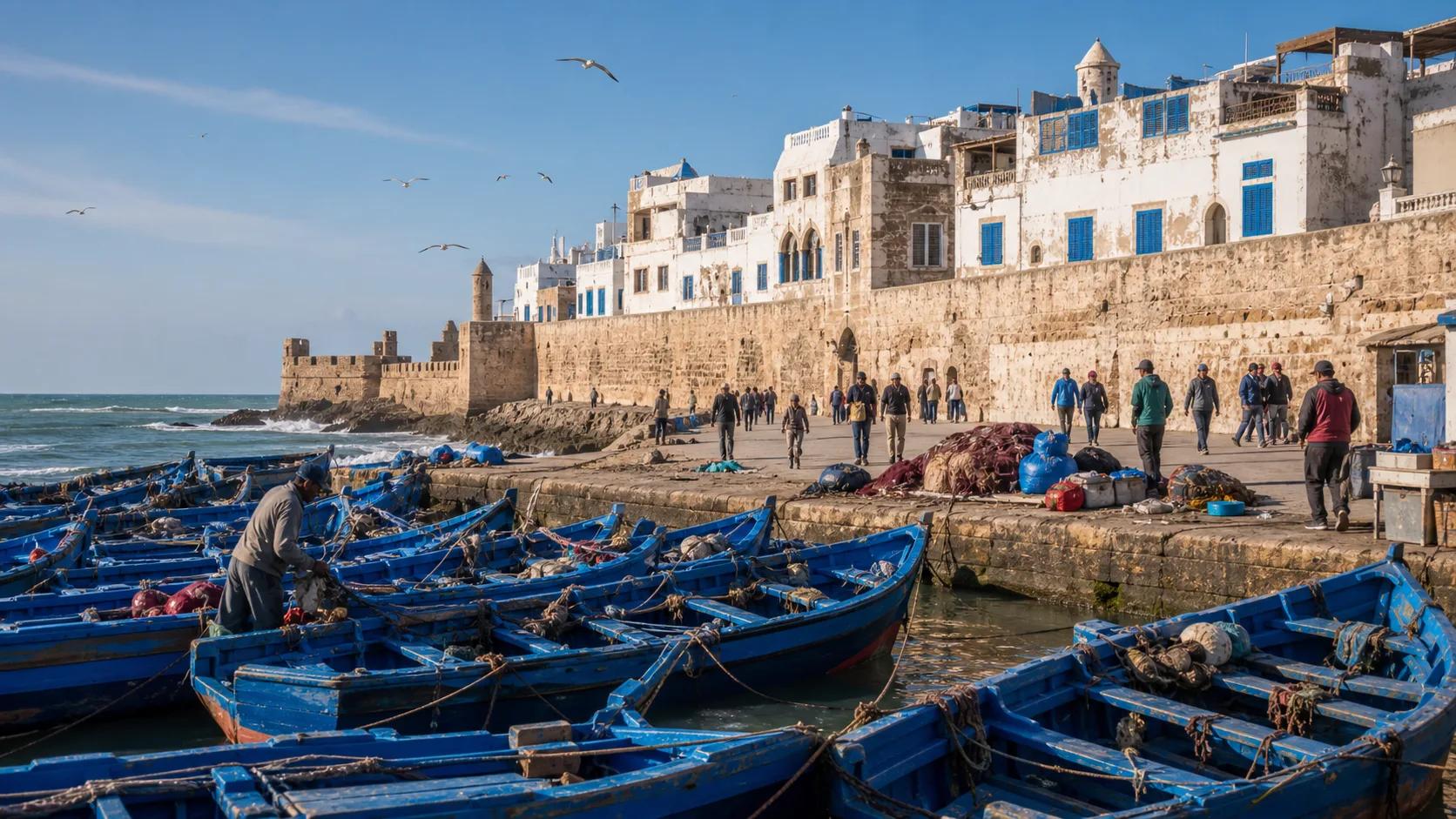
Illustrative: the fish port inside the ramparts. The kite beach runs north of the walls.
The town is nicknamed the Wind City of Africa for a reason: from spring into summer the Alizée blows into the bay most afternoons, often 25 to 35 knots with stronger gusts. The kite zone is the long beach north of the ramparts. It suits wave riders and strong freestylers; learners usually drive 25 km south to Sidi Kaouki. Off the water there is the walled 18th-century medina, a UNESCO site, and its fish port.
Where kiters stay
Riads and hotels inside the medina walls; surf houses closer to the beach.
Getting there
About 3 hours by road from Marrakech, 3.5 hours from Agadir along the coast. Essaouira-Mogador airport (ESU) has some direct flights from Europe.
The headland to the north takes the edge off the Alizée, which leaves enough wind to fly a kite with confidence and enough margin to recover from mistakes. The beach runs for several kilometres over sand. Mornings are the lesson window before the afternoon breeze strengthens. The village is a handful of surf and kite houses and cafés.
Where kiters stay
Surf and kite houses in the village, and a small hotel.
Getting there
30 to 40 minutes by taxi from Essaouira. Several Essaouira schools run their beginner sessions here.
Oualidia
Atlantic coast, between El Jadida and Safi
Season
May to August
Wind
12–20 kn
Direction
NNW, cross to side-onshore in the lagoon
Water
Calm, warm lagoon behind a sand bar
Level
Beginners and families
A crescent lagoon sheltered by a natural sand bar gives calm, shallow water and gentle wind: the most forgiving place in the country for a first lesson. The lagoon has been farmed for oysters since the 1950s, and you eat them at the restaurants on the shore. Weekends bring day visitors from Casablanca; weekdays are quiet.
Where kiters stay
Guesthouses and small hotels on the lagoon edge.
Getting there
About 2 hours by road south of Casablanca; about 1.5 hours north of Safi.
Moulay Bousselham
Atlantic coast, north of Kenitra
Season
May to September
Wind
15–25 kn
Direction
NNW, side-onshore
Water
Protected lagoon plus an ocean beach break
Level
Beginner to intermediate
The Merja Zerga lagoon sits behind a narrow sand spit, flat and shallow and out of the swell. It is a protected wetland and a stop for migrating birds, flamingos and spoonbills among them. Wind fills in through summer afternoons. Facilities are thin: a few guesthouses, limited rental and a fishing village, so bring your own gear.
Where kiters stay
A few guesthouses in the village.
Getting there
About 1.5 hours by road from Rabat.
El Haouzia
Beside El Jadida, about 90 km south of Casablanca
Season
April to September
Wind
15–25 kn
Direction
NNW, side-onshore
Water
Open Atlantic beach, sandy bottom
Level
Intermediate
The everyday spot for kiters based in Casablanca and Rabat: a long open beach with more swell and current than the lagoons, but a sandy bottom and predictable side-shore wind. Local instructors work the beach. El Jadida next door has the Portuguese city and its cistern, a UNESCO site, for an afternoon off the water.
Where kiters stay
Hotels in El Jadida.
Getting there
About 90 minutes from Casablanca on the A3 motorway.
A summer day in Dakhla
The lagoon, hour by hour,as the trade wind builds
The times are typical, not a schedule: the wind decides. Most days follow the same rhythm, light in the morning and strongest through the afternoon.
09:00
Dakhla lagoon · before the wind
Glass water at breakfast
Mornings are often light. It is the hour for a forecast check on Windguru or Windy, a coffee, and a look at the flamingos in the inlets.
11:30
The beach · wind from the NNE
The Alizée fills in
The trade wind builds from late morning, funnelled between the peninsula and the coast. Pump the 12 m on a lighter day; switch to the 9 m once it settles in the mid-twenties.
13:00
Learning zone · knee to waist deep
First session
The wind is side-onshore, so it drifts you back toward the beach, and the water is shallow enough to stand up in after a fall. A shorty wetsuit or boardshorts is enough at about 20 to 24°C.
16:00
Atlantic side of the peninsula
Waves for those who want them
Wave riders cross to the exposed ocean beaches, where the swell breaks with shape. Everyone else keeps going on flat water until the arms give out.
19:30
After sunset
The wind lets go
The breeze eases after sunset. Rinse the kite, hang the harness, and plan tomorrow around the forecast. Leave a spare day or two in the trip in case a day goes light.
What to bring
The kite sizesMorocco asks for
9 m
Your main kite for the common strong days at Dakhla and Essaouira, roughly 22 to 30 knots.
12 m
Lighter mornings and the softer spots, Oualidia and Moulay Bousselham, where 15 to 20 knots is usual.
7 m
Essaouira on its strongest days, 30 to 40 knots. Easy to rent if you would rather not carry it.
10 m
If you bring only one kite, this is the all-round compromise for Morocco.
Board
A 135 to 140 cm twin-tip for the Dakhla flats. Add a directional for waves at Essaouira; strapless surfboards rent from the town’s surf shops.
Wetsuit
Dakhla: boardshorts or a shorty all year. Essaouira and the Atlantic coast: a 3/2 mm from October to May, boardshorts in summer. An impact vest for waves; a helmet is sensible for beginners.
Flying with it
Most airlines carry a kite bag as sports equipment. Add the allowance when you book the flight; adding it at the airport costs more.
Renting instead
Established centres stock most sizes from about 7 to 17 m, and the Dakhla camps carry brands such as Ozone, Cabrinha and Duotone. Reserve your size ahead.
The International Kiteboarding Organization sets the teaching and safety standard most Moroccan schools follow. Ask to see an instructor’s certification before you book, especially at the smaller spots.
9 hIKO Level 1
Kite control on the beach, body dragging, water relaunch and first board starts. Usually spread over three or four days.
+6–9 hIKO Level 2
Riding upwind, transitions, first jumps and self-rescue. After Level 2 you count as an independent rider, and many stations ask for it before they rent to you.
15–20 hTo ride on your own
How long most students take, in total, to become independent. Flat, shallow water like Dakhla’s shortens the curve.
What the schools publish
Typical local prices in dirhams, as schools list them. They change by season and operator, so check locally. On a private trip with us, kite days go into your free quote.
Spot
Beginner course
Full-kit rental
Certification
Languages
DakhlaKite camps (several operators)
3,500–5,000 MAD for a 9-hour Level 1
600–900 MAD a day
IKO Level 1 and 2
English, French, Spanish, German
EssaouiraBeach schools north of the ramparts
3,000–4,500 MAD for a 9-hour Level 1
500–800 MAD a day
IKO Level 1
French, English, Arabic
Sidi KaoukiSmall kite and surf schools
2,800–4,000 MAD for a 9-hour Level 1
400–600 MAD a day
IKO Level 1
French, English
Oualidia, Moulay Bousselham, El HaouziaIndependent local instructors
2,500–3,500 MAD for a 9-hour course
Limited; bring your own
Not always IKO: ask
French, Arabic; some English
Where to stay
Kite camp or independent?
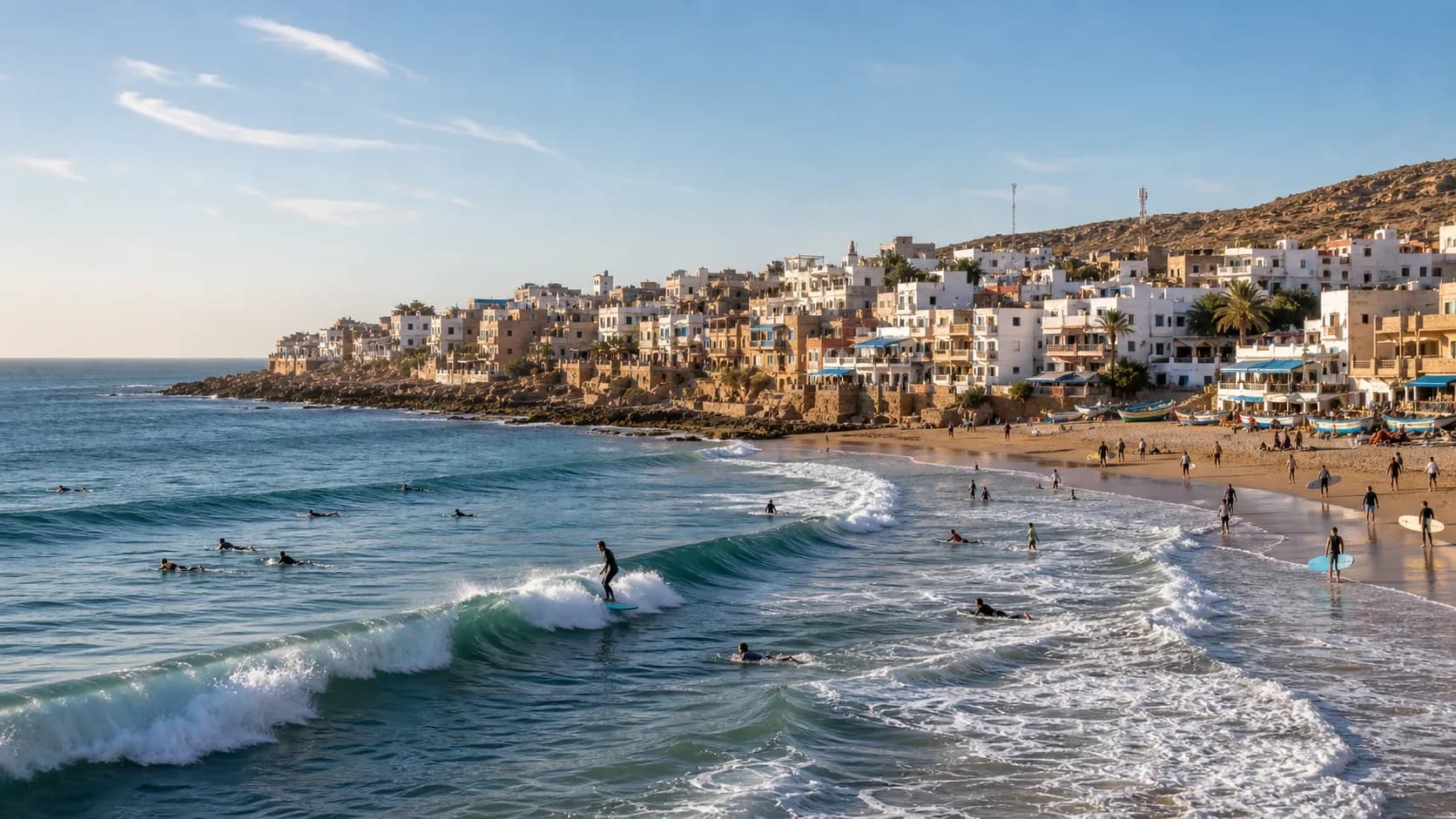
Illustrative: Taghazout, north of Agadir, where surfers spend the flat days.
A kite camp
Rooms, meals, gear, instruction and usually the airport transfer in one booking, with instructors and kit on the beach every day. The right call for a first trip to remote Dakhla, or for anyone learning. The trade-off is less freedom to roam.
Independent
A guesthouse or riad, rental from a kite station, lessons when you want them. More flexible, easier to combine several spots, and suited to experienced riders at Essaouira and the northern lagoons. Book gear ahead in summer.
Both
Over ten days: five at a Dakhla camp for the flat water, then a flight north and five independent days in Essaouira for waves, the medina and the fish grilled at the port.
It depends on the spot. Dakhla rides all year and is most reliable from April to October, with roughly 20 to 35 knots on good days. Essaouira is windiest from April to August, around 20 to 30 knots and often more. Oualidia, Moulay Bousselham and the northern Atlantic spots are best from May to September. Wind varies from year to year, so check a current forecast such as Windguru before fixing your dates.
Is Dakhla really a top kitesurfing destination?
Yes. Dakhla is widely listed among the world’s leading flat-water kite spots, alongside Tarifa, Cabarete and Mauritius. Its lagoon of about 40 km gives flat, shallow water for freestyle and freeride at most levels, with the trade wind side-onshore at around 20 to 35 knots on good days. Water stays about 20 to 24°C much of the year, and established camps offer IKO instruction, gear and rooms. Build in spare days in case the wind drops.
How strong is the wind in Essaouira?
Strong. From April to August good days commonly bring 20 to 35 knots, with higher gusts on the windiest afternoons: the town is nicknamed the Wind City of Africa. That suits experienced kiters and wave riders and is a lot for an absolute beginner. Learners usually take lessons at Sidi Kaouki, 25 km south, or in the quieter mornings.
Can beginners learn to kitesurf in Morocco?
Yes, especially at Dakhla, Sidi Kaouki and Oualidia. Dakhla’s learning zone is knee to waist deep with steady side-onshore wind; Sidi Kaouki has lighter wind than Essaouira; Oualidia’s lagoon is calm and warm. An IKO Level 1 course is about 9 hours over three or four days, and most students ride independently after roughly 15 to 20 hours in total. Schools publish course rates of roughly 3,500 to 5,000 MAD at Dakhla; check locally.
What size kite should I bring?
A 9 m and a 12 m make a good quiver for Dakhla and Essaouira: the 9 m for the common strong days, the 12 m for lighter days and mornings. A 7 m helps on the strongest Essaouira days. If you bring one kite, bring a 10 m. Most sizes from about 7 to 17 m rent at the established centres.
How much does kite rental cost in Morocco?
At established centres a full kit (kite, bar, board, harness) runs roughly 600 to 900 MAD a day at Dakhla and less at the smaller spots, with weekly packages cheaper per day. Many camps include rental in their package. These are third-party rates that change; confirm them with the school when you book.
What is the wind direction in Dakhla?
North-northeast for much of the year, from the Alizée trade wind. That makes it side-onshore across the lagoon, which keeps riders drifting back toward the beach. The wind funnels between the peninsula and the coast, builds from late morning through the afternoon and eases after sunset.
Kite camp or independent travel?
Both work. A Dakhla camp bundles gear, instructors, rooms, meals and usually airport transfers, which suits beginners and short trips to a remote place. Independent travel, with a guesthouse and rental from a station, gives more freedom and suits experienced kiters at Essaouira, Sidi Kaouki and Moulay Bousselham, which are easier to reach on your own than Dakhla.
Can you build a kite trip into a private Morocco itinerary?
Yes. We plan private trips with your own driver and vehicle, so a few days on the water can sit beside Marrakech, the desert or the coast road. Tell us your level, your dates and how many kite days you want; a planner in Casablanca replies within 24 hours with a route and a free quote.
ⴰⵣⵓⵍazul · hello, in Tamazight
Kite days, and the rest of Morocco.
We plan private trips with your own driver and vehicle, so a few days on the water can sit beside Marrakech, the desert or the coast road. Tell us your level, your dates and how many kite days you want; a planner in Casablanca replies within 24 hours with a route and a free quote.
Private
Your own vehicle, driver and local guides. Never a group bus.
Local
A Morocco-based team in Casablanca plans and supports the trip.
24 hours
A planner replies within a day. The quote is free.