City guide · Marrakech
Marrakech city guide: the Red City, hour by hour.
Walk along the ramparts at dawn, the souks in the morning, a garden at noon and the palaces in the afternoon, then reach Jemaa el-Fna as the stalls light up at dusk.
Marrakech, hour by hour
Marrakech, the Red City, read by the sun.
Marrakech was founded by the Almoravids in the 11th century, and its walls are pisé: red earth, lime and gravel rammed into wooden forms. The colour gives the city its nickname, the Red City. The medina inside the walls is a UNESCO World Heritage site.
Shutters go up in the souks in the morning. When the sun is high, you want a garden; in the afternoon, the thick walls of a palace. Jemaa el-Fna fills at dusk.
For a longer list, read things to do in Marrakech or the Marrakech travel guide, sight by sight.
Dawn
The ramparts and the Koutoubia
Before the souks open, walk the outside of the walls or the gardens of the Koutoubia. The light is low, the earth turns pink, and the lanes are nearly empty.
- The Koutoubia
- The minaret of the Almohad mosque, built in the 12th century, stands over the gardens west of Jemaa el-Fna. The gardens around it are open to everyone.
- The walls
- The ramparts were first raised by the Almoravids in the 12th century, in pisé: earth, lime and gravel rammed into wooden forms. The holes you see in rows are where the beams of the formwork sat.
- Bab Agnaou
- The carved stone gate into the kasbah quarter, from the Almohad period. Most gates are plain earth; this one is dressed stone with a band of inscription.
- Bab Doukkala
- The gate on the north-west side, towards Gueliz and the Jardin Majorelle.
Morning
The souks of Marrakech, trade by trade
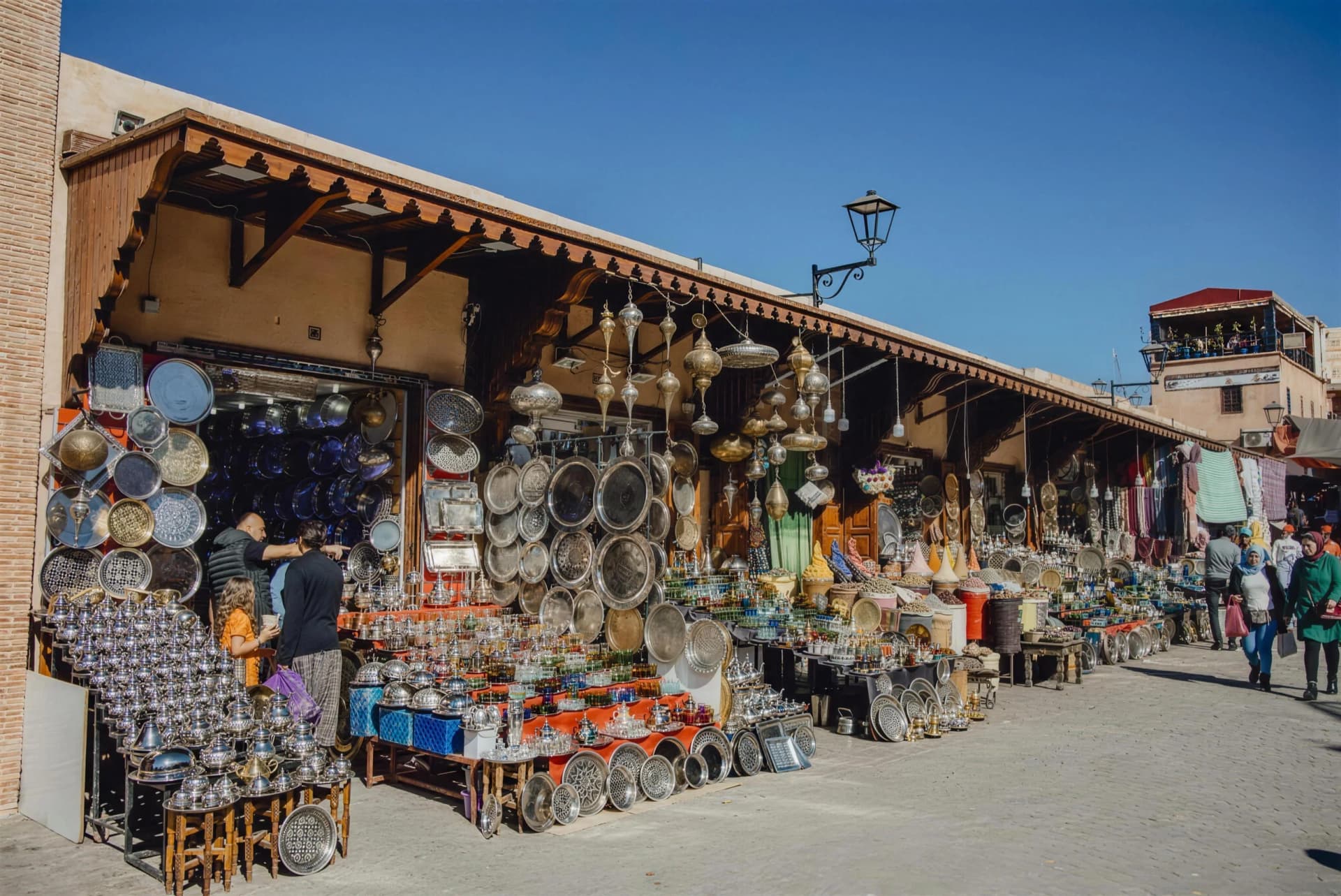
The souks spread north of Jemaa el-Fna, and each lane is named for the trade it holds. Mornings are quieter, and you can watch the workshops at work.
Souk Semmarine
The main covered street
Runs north from Jemaa el-Fna under a lattice roof: textiles, kaftans, slippers, and the forks into every other souk.
Rahba Kedima
Spices and herbalists
The old square of the spice sellers: cumin, ras el hanout, dried rosebuds, black soap, argan oil.
Souk des Teinturiers
The dyers
Skeins of dyed wool and silk hung up to dry over the lane.
Souk Haddadine
The smiths
Ironwork beaten and cut by hand: lanterns, grilles, door knockers.
Souk Cherratine
Leather
Slippers, bags, belts and poufs, often made in the workshops behind the stalls.
Souk Zarbia
Carpets
The carpet square, where rugs from the Atlas villages are laid out and unrolled for buyers.
Bargaining, politely
- Ask the price, then offer what it is worth to you. Both sides expect to meet somewhere between.
- Keep it friendly and unhurried. If you do not agree, thank the seller and move on.
- Look at the same thing in two or three shops before you buy.
- A state craft centre, the Ensemble Artisanal, usually marks its prices, which helps you judge a fair one.
- Carry dirhams in small notes. Many stalls take cash only.
Inside the walls, and outside them
Marrakech’s quarters: medina, kasbah, Mellah, Gueliz.
Three quarters sit inside the ramparts and three grew outside them. Where you stay changes how you spend the day.
The medinainside the walls
Inside the walls: the souks, the riads, Jemaa el-Fna, the Ben Youssef medersa. Most lanes are on foot only.
The kasbahinside the walls
The south of the old city, through Bab Agnaou: the Saadian Tombs, the royal palace walls, quieter lanes.
The Mellahinside the walls
The old Jewish quarter, beside the Bahia and El Badi palaces: the Lazama synagogue and the Miara cemetery.
Guelizoutside the walls
The new town north-west of the walls, laid out under the French Protectorate: Avenue Mohammed V, galleries, shops, cafés.
Hivernageoutside the walls
Outside the western walls, south of Gueliz: wide avenues and larger hotels.
The Palmeraieoutside the walls
The palm grove on the north-east edge of the city, with villas and resorts among the palms.
Noon
Gardens in Marrakech: Majorelle, Menara, Agdal
When the sun is high, go where there is shade and water. Marrakech has kept gardens since the Almohads.
- Jardin Majorelle
- Laid out by the painter Jacques Majorelle from the 1920s, bought by Yves Saint Laurent and Pierre Bergé in 1980. Cactus beds, bamboo, and the villa in the blue that carries his name. The Musée Yves Saint Laurent stands next door.
- The Menara
- An Almohad water basin in an olive grove west of the city, with a pavilion on its edge and, on clear days, the High Atlas behind.
- The Agdal
- The walled orchards south of the royal palace, part of the World Heritage site with the medina. Opening days vary.
- Le Jardin Secret
- A restored riad garden in the Mouassine quarter of the medina, with its old water channels running again.
Afternoon
Bahia, El Badi and the Saadian Tombs
The south of the medina holds the royal and vizier palaces, the Saadian Tombs and the old Jewish quarter, all within a short walk of each other. Thick walls keep them cool in the afternoon.
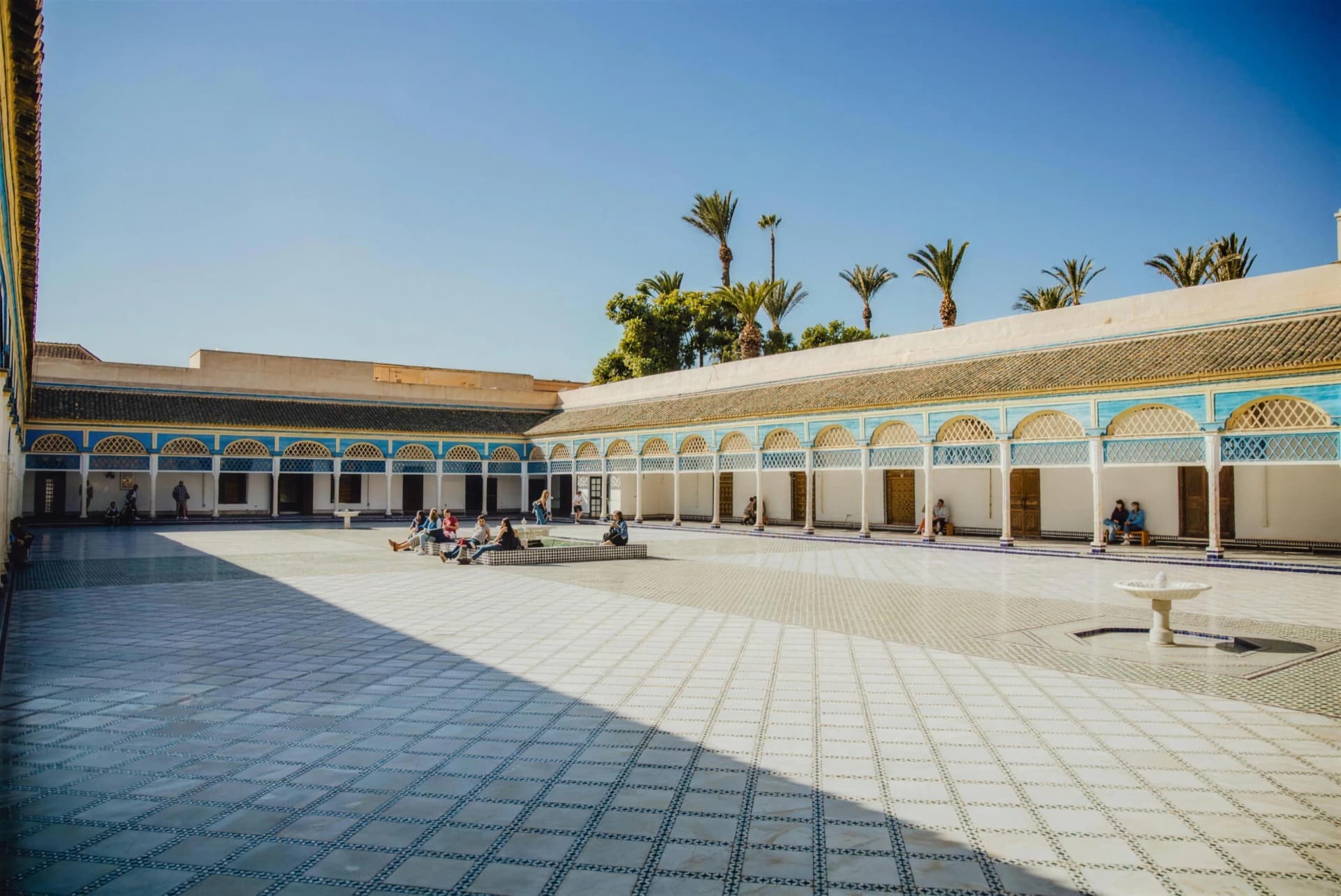

- Bahia Palace
- Built in the late 19th century for the grand viziers Si Moussa and his son Ba Ahmed: marble courtyards, painted cedar ceilings, carved stucco, planted patios.
- Saadian Tombs
- The 16th-century burial place of the Saadian sultans, walled off for centuries and brought back to light in 1917.
- El Badi Palace
- Built by the Saadian sultan Ahmad al-Mansur from 1578, later stripped of its marble under the sultan Moulay Ismail. The sunken gardens and the high earth walls remain, with storks on top.
- Ben Youssef Medersa
- A Quranic college founded in the 14th century and rebuilt under the Saadians: a courtyard of zellige, carved cedar and stucco, with the students’ cells above.
- Dar Si Said
- A 19th-century house in the medina, now a museum of Moroccan carpets and weaving.
Opening days and times change; we confirm them for your dates. A local private guide on the first afternoon makes the history readable. The palaces guide
Dusk
Jemaa el-Fna
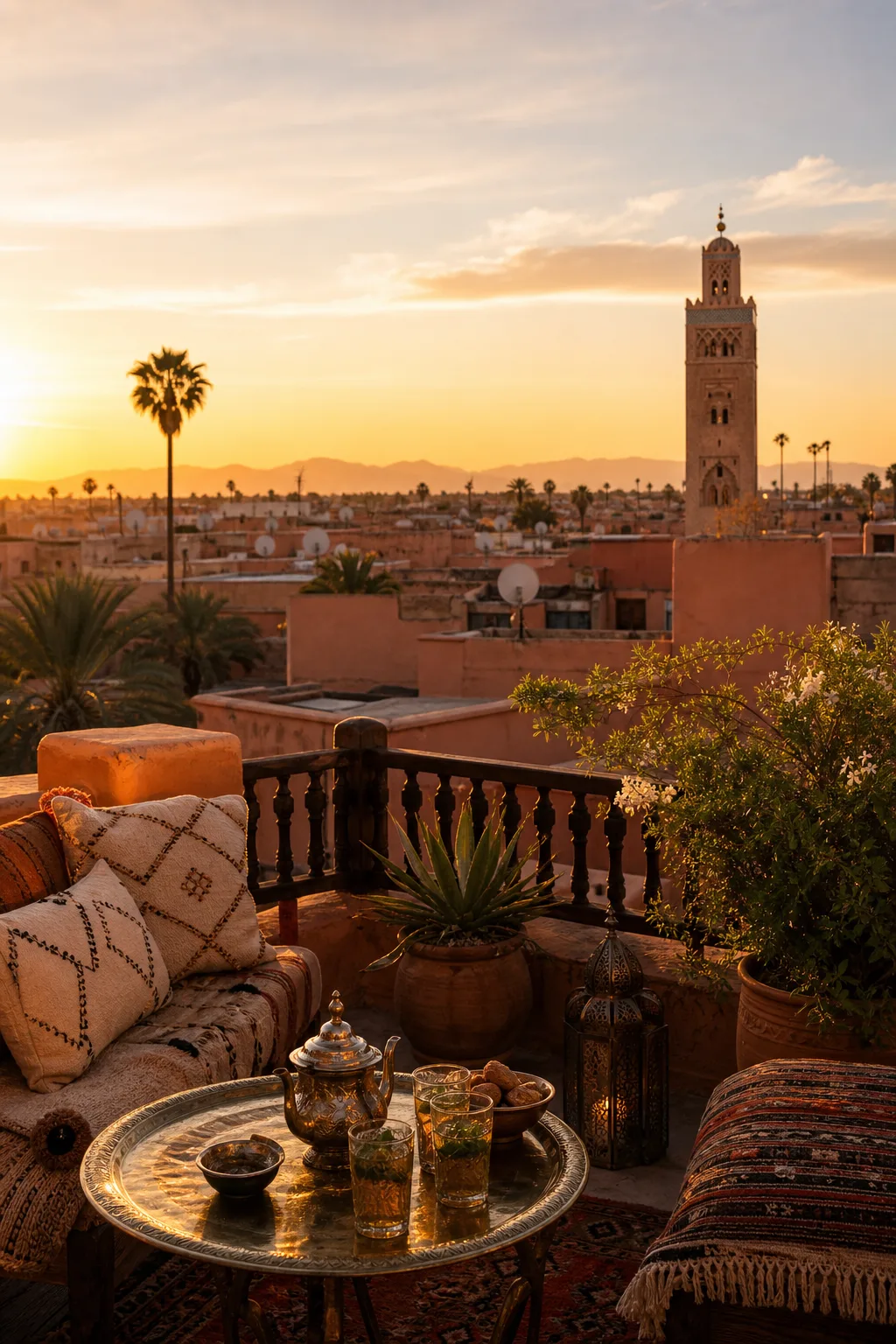
The square below the Koutoubia changes through the day. By late afternoon the food stalls are set up in rows, and after sunset the square fills with grills, musicians, storytellers and the crowds around them.
UNESCO named the cultural space of Jemaa el-Fna a Masterpiece of the Oral and Intangible Heritage of Humanity in 2001.
Watch from a terrace on the edge of the square as the light goes, then walk down into it. Performers expect a tip if you photograph them; agree the price before you sit at a stall.
The next morning
Day trips from Marrakech
Out through the gates in the morning, back to the same room by evening. Drive times are at the wheel, each way, before stops.
The Agafay desert
Half day · About an hour
A stony plateau with the High Atlas on the horizon; a camel ride or sunset at a camp. Not sand dunes.
The Ourika Valley
Half day · About an hour and a half
Amazigh villages on the valley slopes, the Setti Fatma falls, lunch by the river.
Imlil and the High Atlas
Full day · About an hour and a half
The village below Jebel Toubkal, a walk through walnut orchards with a local mountain guide.
The Ouzoud waterfalls
Full day
Tiered falls into a gorge, Barbary macaques in the olive trees, a path down to the pools.
Essaouira
Full day · Around three hours each way
The Atlantic port: the medina inside its sea walls, the harbour and its blue boats.
Ait Benhaddou
Long full day · Over the Tizi n’Tichka pass
The earthen ksar above the Ounila river. It sits better as the first stop of a longer trip south.
The Sahara dunes are not a day trip from Marrakech (see the questions below). A private night in the Sahara
How long, and when
How many days in Marrakech?
- 2 days
- The medina: the souks, Jemaa el-Fna, one palace, one garden.
- 3 days
- The same at an easy pace, with the kasbah quarter and the Mellah.
- 4–5 days
- Three city days and one or two days out, to the Atlas valleys, Agafay or Essaouira.
Best time to visit Marrakech: the weather, month by month
Spring and autumn are the easy seasons. In July and August, see the city early and late, and spend the hot hours indoors.
- 18°6°Jan: average high 18°C, low 6°C
- 20°7°Feb: average high 20°C, low 7°C
- 23°10°Mar: average high 23°C, low 10°C, one of the best months
- 25°12°Apr: average high 25°C, low 12°C, one of the best months
- 29°15°May: average high 29°C, low 15°C, one of the best months
- 33°18°Jun: average high 33°C, low 18°C
- 38°21°Jul: average high 38°C, low 21°C, the hottest months
- 37°21°Aug: average high 37°C, low 21°C, the hottest months
- 32°18°Sep: average high 32°C, low 18°C
- 27°14°Oct: average high 27°C, low 14°C, one of the best months
- 22°10°Nov: average high 22°C, low 10°C, one of the best months
- 19°7°Dec: average high 19°C, low 7°C
Before you go
Getting there, getting around, and the courtesies
Private transfers from Marrakech airportMorocco etiquetteIs Morocco safe?
- Arriving by air
- Marrakech Menara Airport (RAK) is on the edge of the city, a short drive from the medina. On a trip with us, your driver meets you in arrivals.
- Arriving by train
- Marrakech is the southern end of the national railway, with trains from Casablanca, Rabat and the north.
- Getting around
- The medina is a walking city: cars cannot reach most lanes, so luggage goes the last stretch by hand cart. Petit taxis cover the rest of town; ask for the meter or agree the fare first.
- Dress
- Clothes that cover shoulders and knees are the considerate choice in the medina and in villages.
- Photographs
- Ask before you photograph people.
- Mosques
- Active mosques, the Koutoubia included, are open to Muslims only. The Ben Youssef Medersa is not a mosque and is open to visitors.
Trips that start here
Marrakech, privately
Each one is a starting point. Your travel designer sets the stays, the days out and the pace around you.
- Private Marrakech toursThe city with your own local guide, by the day or as part of a trip.See the trip
- A luxury Marrakech holidayOne base in the city, private days out to the mountains, the desert edge and the coast.See the trip
- Day trips from MarrakechEvery private day out from the city, compared.See the trip
- Over the Atlas to the kasbahsThe mountain road south of Marrakech, privately.See the trip
- A private night in the SaharaA camp night in the Erg Chebbi dunes, privately.See the trip
- The imperial citiesMarrakech with Fes, Meknes and Rabat.See the trip
After you ask for a quote
What reaches you after you ask
Your proposal contains
- A day-by-day route, with the driving time between stops
- Stays matched to your style (riads, kasbahs, desert camps or hotels), named so you can look them up
- Which moments are private to you, and which are shared, such as a camp’s dining tent
- An itemised quote: what is included and what is not
- Who is planning your trip, and how to reach them on WhatsApp
- Free, with no obligation to book
Before you pay a deposit, we confirm
- Opening days for the places on your route, including Friday and holiday closures
- Meal stops along the way, and any dietary needs
- Prayer or Shabbat timing, if it matters to you
- Step-free access, wherever you need it
- The vehicle class for your group and your luggage
Every trip is private and priced to your dates, so there is no fixed price list. Ask, and the proposal shows the full cost before anything is booked.
Marrakech questions, answered
How many days do you need in Marrakech?
Three days covers the medina, the souks, the palaces and a garden at an easy pace. Add a day for each day trip, such as the Atlas valleys or Essaouira. Two days is enough for the medina alone.
When is the best time to visit Marrakech?
The most comfortable months are March to May, then October and November. Average highs are about 25°C in April and 27°C in October. July and August are the hottest months, with average highs of 38°C and 37°C, so plan sightseeing for the early morning and the evening.
Is Marrakech safe for visitors?
Yes, for most visitors; the problems are petty: pickpockets in crowds, men offering directions for a fee, and scooters in narrow lanes. Agree prices before a service, keep your phone in a front pocket, and walk the medina with a local guide on your first day if you prefer.
Should I stay in the medina or the new town?
Stay in the medina to walk to the souks and the square; most riads are there, and cars cannot reach most lanes. Stay in Gueliz or Hivernage for larger hotels with car access. The Palmeraie suits a stay with more space and a pool, outside the centre.
What does a private Marrakech trip with Serenity Morocco Tours include?
A 100% private trip: a private driver-guide, local private guides in the medina, airport meet-and-greet, every reservation made by our team, a pre-departure briefing, and WhatsApp +212 701 664 704 during the trip. Stays are chosen for each trip: a riad, a hotel, or a kasbah hotel or desert camp beyond the city.
Can I see the Sahara from Marrakech?
Not as a day trip. From Marrakech, the dunes of Erg Chebbi take at least three days as a round trip, and five days or more give the drive room. The Agafay desert, about an hour away, is a stony plateau, not dunes.
How much does a trip to Marrakech cost?
It depends on the season, the stays, the days out and the size of your group. We do not publish fixed prices; each trip is quoted for you, free, with a reply within 24 hours.
Send your dates for Marrakech
المغربⵜⴰⴳⵍⴷⵉⵜ ⵏ ⵍⵎⵖⵔⵉⴱThe Kingdom of Morocco