
Money in Morocco:dirhams, cards and tipping.
Morocco runs on the dirham, a closed currency: take it from a bank ATM after you land, carry small notes, and keep cash for medinas, souks, taxis and the countryside. Cards work in hotels and upscale restaurants. Tipping is customary, in cash.
- Currency
- Moroccan dirham (MAD)
- Divided into
- 100 centimes
- Buy it
- After you land
- Pay with
- Mostly cash
- Tipping
- Customary, in cash
The currency
The Moroccan dirham (MAD).
The currency is the Moroccan dirham (MAD), divided into 100 centimes. Coins come in 0.5, 1, 2, 5 and 10 dirhams; notes in 20, 50, 100 and 200.
The dirham is a closed currency: you cannot buy it before you travel, and only a small amount may be taken out of the country, so get it after you land and change or spend what is left before you fly home.
You will often see it written as MAD, DH or Dhs on price tags and menus.

The notes, and what each is handy for
- 2020 dirhamsTips, mint tea, small buys in the market.
- 5050 dirhamsTaxis, snacks and lunch at a local café.
- 100100 dirhamsMarket shopping and meals out.
- 200200 dirhamsThe largest common note, and often hard to break in small shops.
Coins: 0.5, 1, 2, 5 and 10 dirhams. Centime coins exist but are rarely used day to day.
Notes drawn as an illustration, not to scale.
Cash or card?
From the souk to the hotel: where cards work.
Morocco is still mostly a cash economy outside hotels and upscale restaurants. Read the rail from left (cash only) to right (cards fine).

Cash only
- Street food
- Petits taxis
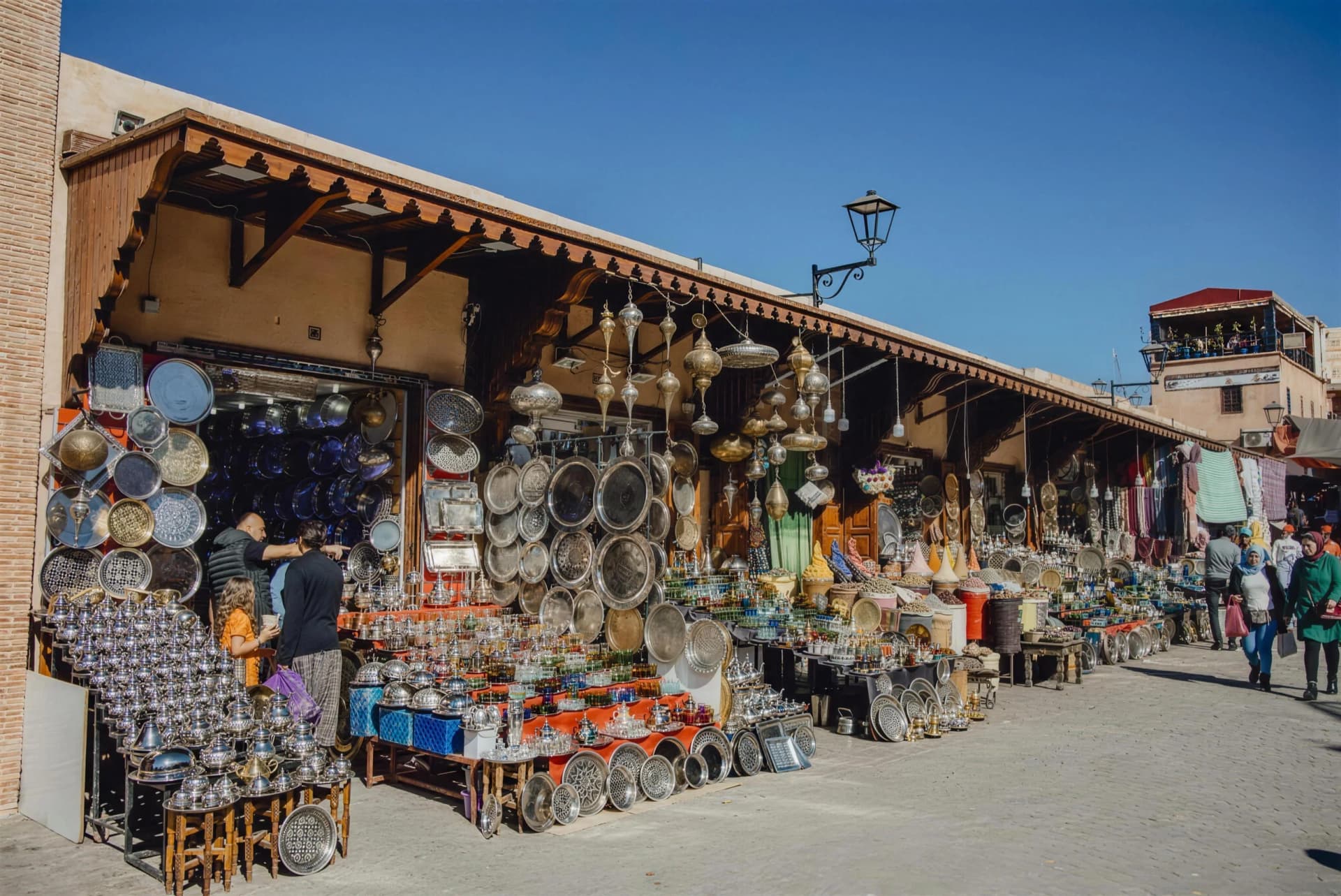
- Medina shops and souks
Mostly cash
- Small restaurants and cafés
- Markets in the countryside
It varies
- Shops in the new towns
Mostly cards
- Larger restaurants (ask first)
Cards fine
- Upscale hotels and riads
Contactless and phone payments are not widely accepted yet, so don’t rely on them. Some places add a fee for cards; ask before you pay.
Getting dirhams
Where to get cash, and where not to.
Use
- Bank ATMs. Usually the easiest and fairest way: BMCE, Attijariwafa Bank, Banque Populaire and CIH are widely found. Use machines in or beside a bank branch.
- Bank branches. Official rates; bring your passport and allow some time.
- Exchange bureaus. In tourist areas; rates vary, so compare two or three first.
Avoid
- The airport counter. Convenient, poor rates. Change only what you need for the first day.
- Hotels. The poorest rates, with commission built in. A last resort.
- Street exchangers. Illegal, and a risk of fraud and counterfeit notes. Never change money with strangers.
At the ATM
- Visa and Mastercard work in most ATMs; American Express much less often.
- When the machine offers to charge you in your home currency, choose dirhams: the machine’s conversion is the worse one.
- Your bank may charge for foreign withdrawals; check before you travel, and tell it where you are going.
- Carry a second card from a different bank in case one is blocked or swallowed.
- Look over the card slot before you use a standalone machine in a busy tourist area.
Tipping
Who to tip, and when.
- Guides
- Drivers
- Desert camp staff
- Riad staff, at checkout
- Porters
- Hammam attendants
- Restaurant servers
- At sit-down restaurants, unless a service charge is already on the bill.
- For guides and drivers, at the end of the day or the trip.
- For riad staff, at checkout; for porters, when they carry your bags.
- For hammam attendants, after the treatment.
- For taxi drivers, by rounding up.
- Tips can also be included in your quote, so you don’t have to think about them on the road.
Splitting the bill
In traditional Moroccan settings, the host pays: it is cultural and not up for discussion.
In tourist restaurants, splitting the bill is understood and accepted.
If you are invited to a Moroccan home, never offer to pay. Bring a gift instead: pastries, dates or good tea.

How much to budget? It depends on five things.
We don’t publish price lists: they go stale and rarely fit your trip. What you spend depends on the season, how many of you share the car and rooms, the level of your stays, how far the route runs, and whether it is private or shared. Send us those and a planner replies within 24 hours with an itemised quote, free.

Stay sharp
Five money tricks to see coming.
The “free” guide
Someone offers to show you the way for free, then asks for a large payment at the end. Agree a price first, or decline politely.
The broken card machine
A shop says its card machine is broken to push you into paying cash at a higher price. Walk away if it feels wrong.
ATM skimmers
Prefer ATMs inside or beside bank branches, and check for loose card readers.
Short change
Count your change, especially after paying with a big note.
The commission
If someone leads you to a shop, part of what you pay may go to them as commission. Factor that into your bargaining.
Money in Morocco: your questions
What currency is used in Morocco?
The currency is the Moroccan dirham (MAD), divided into 100 centimes. Coins come in 0.5, 1, 2, 5 and 10 dirhams; notes in 20, 50, 100 and 200. The dirham is a closed currency: you cannot buy it before you travel, and only a small amount may be taken out of the country, so get it after you land and change or spend what is left before you fly home.
Do I need cash in Morocco?
Yes. Cards work in hotels, upscale restaurants and larger shops, Amex less often. Medinas, souks, street food, local cafés and the countryside run on cash, and some places add a fee for cards. Take dirhams from a bank ATM after you land, carry small notes, and change or spend what is left before you fly home.
Should I bring dirhams with me?
You do not need to bring dirhams: it is a closed currency, so take it from a bank ATM after you land and carry small notes for tips, taxis and markets. Keep some cash as a back-up even if you pay most things by card, and change or spend what is left before you fly home.
Where is the best place to get dirhams?
A bank ATM, in or beside a bank branch, is usually the easiest and fairest. Exchange bureaus in tourist areas are fine if you compare a few. Change only a little at the airport and avoid hotels and street exchangers.
Can I use my card in Morocco?
Cards work in hotels, upscale restaurants and larger shops, Amex less often. Medinas, souks, street food, local cafés and the countryside run on cash, and some places add a fee for cards.
Who should I tip in Morocco?
Tips are customary and matter to people’s income: guides, drivers, desert camp staff, riad staff, at checkout, porters, hammam attendants, restaurant servers. Tip in dirhams, in cash. Tips can be left to you or included in a quote, and a planner can suggest what is usual for your trip.
Are there limits on taking money in or out of Morocco?
Declare foreign currency worth 100,000 dirhams or more to customs when you enter or leave Morocco. Only a small amount of dirham notes may leave the country, so change or spend the rest before you fly home, and check the current limit with the Office des Changes. (Rules checked October 2026 against UK travel advice; confirm before you fly.)
After you ask for a quote
What you get within 24 hours
Your proposal contains
- A day-by-day route, with the driving time between stops
- Stays matched to your style (riads, kasbahs, desert camps or hotels), named so you can look them up
- Which moments are private to you, and which are shared, such as a camp’s dining tent
- An itemised quote: what is included and what is not
- Who is planning your trip, and how to reach them on WhatsApp
- Free, with no obligation to book
Before you pay a deposit, we confirm
- Opening days for the places on your route, including Friday and holiday closures
- Meal stops along the way, and any dietary needs
- Prayer or Shabbat timing, if it matters to you
- Step-free access, wherever you need it
- The vehicle class for your group and your luggage
Every trip is private and priced to your dates, so there is no fixed price list. Ask, and the proposal shows the full cost before anything is booked.
Who plans your trip

Leave the sums to us.
المغربⵜⴰⴳⵍⴷⵉⵜ ⵏ ⵍⵎⵖⵔⵉⴱThe Kingdom of Morocco