Season MMXXVIFrom Marrakech to the Sahara, privately kept.Plan Your Journey
High Atlas & Anti-Atlas
Morocco Mountain Villages & Berber Valleys
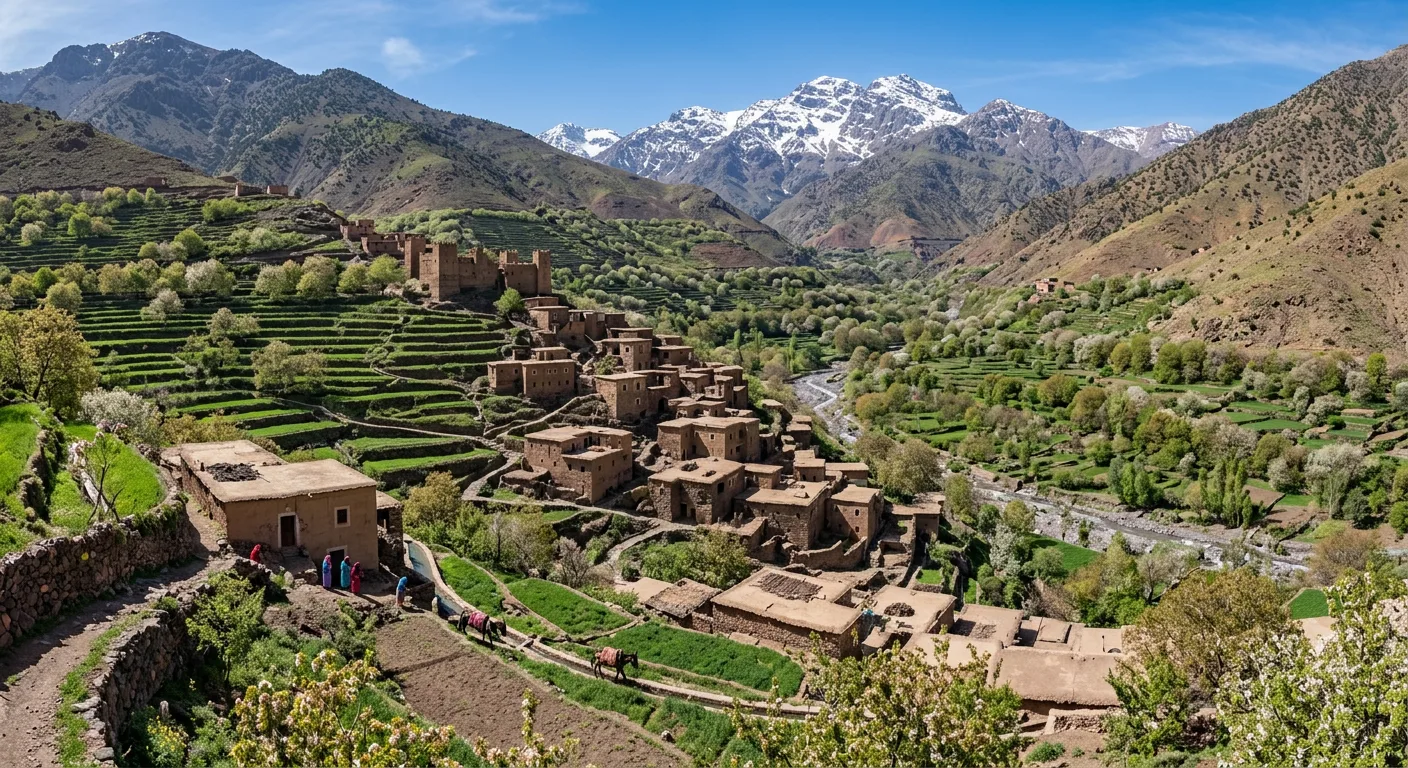
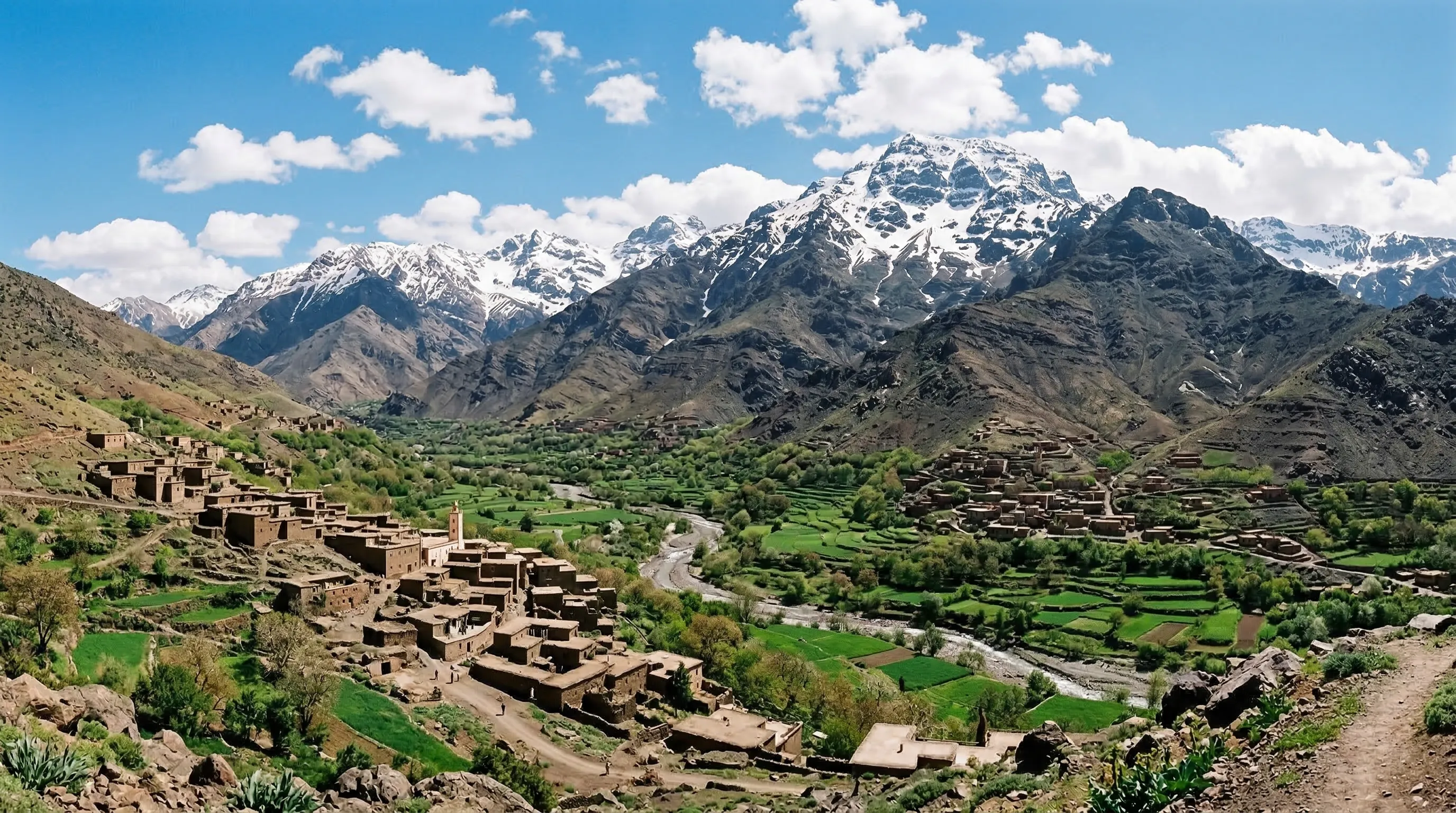
Where time slows to the rhythm of mule bells and terraced barley fields, Morocco's Atlas mountains shelter some of the most intact Amazigh communities on earth. Eight villages, eight worlds — all within reach of a determined traveller.
Private only·Named travel designers·Free cancellation up to 48h
8 villages profiled
Updated May 2026
Expert local guidance
Why Visit Remote Berber Villages?
Morocco's most intact Amazigh (Berber) communities live high in the Atlas mountains, where terraced farms, communal granaries and seasonal rhythms have endured for centuries. The easiest base is Imlil (1,740 m), reachable by standard car about 1.5 hours from Marrakech and the gateway to Jebel Toubkal. More remote valleys — Ait Bouguemez (“Happy Valley”), Zaouiat Ahansal, Tacheddirt, Imilchil, and the Anti-Atlas villages around Tafraout — generally need a 4WD or a hike in from a trailhead. Spring (March–May) and autumn (September–November) are the best seasons; a licensed guide (400–700 MAD/day) is legally required inside Toubkal National Park and strongly recommended elsewhere. Stay overnight in a family gite (100–350 MAD/person) for the most rewarding experience.
Morocco's imperial cities — Marrakech, Fes, Rabat — have drawn travellers for centuries. But the country's soul lives higher, in the Atlas mountains where the Amazigh people, ancestors of North Africa's original inhabitants, have farmed the same terraces, herded the same transhumant flocks, and maintained the same seasonal rhythms for thousands of years. These are not museum pieces. They are living communities of extraordinary resilience and hospitality.
Visiting remote Berber villages offers what no medina can: the unscripted encounter. A family invitation for mint tea in a mud-brick courtyard. An elder showing you the ancient agadir — communal granary — built to store collective wealth through drought and war. Children chasing chickens across a harvest-gold terrace against a backdrop of 3,000-metre limestone walls. These moments lodge in memory far more durably than any souvenir.
The aesthetic case is equally compelling: the Atlas mountains produce scenery of genuine grandeur. Snow-streaked ridgelines, walnut-shaded valleys, rivers cold enough to take your breath away, and at night, an absence of light pollution that makes the Milky Way a physical presence. For photographers, hikers, and anyone exhausted by tourist infrastructure, the Atlas villages deliver something increasingly rare — authentic encounter.
This guide covers eight distinct communities across the High Atlas, Central High Atlas, Anti-Atlas, and Lake District. Each entry includes elevation, travel logistics, what to see and do, accommodation, and the ideal season. Used responsibly, this information connects you with communities that genuinely benefit from thoughtful visitors.
Each village occupies a distinct ecological niche and cultural character. Together they represent the breadth of Amazigh mountain life across Morocco's ranges.
1,740 m elevation
1.5 h from Marrakech
High AtlasGateway to Toubkal
Imlil
At 1,740 metres, Imlil sits in the Mizane Valley and serves as the principal gateway to Jebel Toubkal (4,167 m), North Africa's highest peak. The village itself has grown substantially around its trekking economy — you'll find a concentration of guide associations, mule handlers, gites, and equipment rental shops along its single main lane. Despite the infrastructure, Imlil retains a working-village feel: irrigation channels run along every path, apple orchards frame the lane above town, and the calls of the muezzin from the village mosque mark the day's rhythm.
What to see and do
— Summit Toubkal via the standard two-day route (guide required)
— Walk the apple orchards and irrigation channels above town
— Visit the Kasbah du Toubkal for panoramic terrace views
— Trek to Aroumd village (45 minutes above Imlil)
— Day hike to the Tizi n'Mzik pass (2,489 m) without a Toubkal permit
Accommodation: Gites from 150 MAD/person, Kasbah du Toubkal from 1,200 MAD/room
Best season: April–June, September–November; Toubkal summit possible July–August
High AtlasAbove Imlil
Aroumd
Forty-five minutes of steep walking above Imlil brings you to Aroumd at 1,940 metres — high enough to feel genuinely remote, close enough for a manageable half-day from Marrakech. The village occupies a rocky spur above the walnut grove-filled Mizane gorge, and the contrast with Imlil is immediate: no commercial infrastructure, no persistent vendors, just stone houses stacked against a cliff face and children playing on the flat rooftops. Walnut trees dominate the landscape; the autumn harvest (September to October) sees whole families gathering beneath them. The views of the Toubkal massif from the upper village are among the finest accessible to non-climbers in the High Atlas.
What to see and do
— Walk the walnut grove irrigation system below the village
— Photograph the tiered stone houses against the Toubkal cirque
— Arrange tea with a local family through your guide
— Continue trekking to Tacheddirt via the Tizi n'Tamatert (2,279 m)
— Witness the autumn walnut harvest (September to October)
Accommodation: 2 family gites, 100–180 MAD/person with dinner and breakfast
Best season: April–June, September–October (autumn walnut season especially rewarding)
1,940 m elevation
45 min walk above Imlil
Ait Bouguemez
Happy Valley
1,800 m elevation
3 h from Beni Mellal (4WD)
Central High AtlasThe Happy Valley
Ait Bouguemez (Happy Valley)
The Valley of the Happy People earns its name. At 1,800 metres, this broad, sun-filled valley in the Central High Atlas contains 26 villages of the Ait Bou Oulli federation, strung along a valley floor of extraordinary agricultural productivity. Barley and wheat terraces, divided by poplar windbreaks and irrigation channels, fill the flat land between the river and the limestone ridges. The scale is generous — nothing cramped or shadowed here — and the community visible: women in bright aprons carrying bundles of fodder, mule carts moving between plots, a kasbah-style grain tower (agadir) watching over the valley from a rocky knoll. Tabant, the administrative centre, hosts a weekly market that functions as the social hub for the surrounding communities.
What to see and do
— Attend the Tuesday or Thursday market in Tabant
— Trek through the valley's 26 villages on a half-day loop
— Visit the ancient agadir (communal granary) above the valley floor
— Use as basecamp for the Mgoun massif (4,071 m) approach
— Witness spring barley planting (March) or autumn harvest (September)
Accommodation: Multiple gites in Tabant and surrounding villages, 120–200 MAD/person
Best season: March–May, September–November; summer busy with domestic tourists
Central High AtlasClimbers' Village
Zaouiat Ahansal
At 1,600 metres in a deep canyon carved by the Ahansal river, Zaouiat Ahansal occupies one of the most dramatically isolated positions of any settled community in Morocco. The village was historically accessible only by multi-day mule tracks over high passes. Today a piste from Ait Bouguemez reaches it, but the road remains challenging and the journey (3–5 hours) is part of the experience. The setting — vertical limestone walls rising 400 metres from the valley floor — made Zaouiat Ahansal Morocco's foremost rock climbing destination, with routes of up to 600 metres on immaculate calcite limestone. Non-climbers come for the exceptional canyon hiking, the ancient zawiya (religious school) that gave the village its name, and the profound sense of having reached somewhere genuinely far from the tourist trail.
What to see and do
— Canyon hiking in the Ahansal gorge (half and full day options)
— Rock climbing on the limestone towers (bring your own gear)
— Visit the historic zawiya (ask permission before entering)
— Trek the Ahansal traverse to Ait Bouguemez (3 days)
— Birdwatch for raptors nesting in the canyon walls
Accommodation: 2 basic gites, 100–150 MAD/person; wild camping in the canyon possible
Best season: March–May (spring canyon colour), October–November; summer very hot
Zaouiat Ahansal
Canyon & Climbing
1,600 m · 3-5 h from Ait Bouguemez
Tacheddirt
Highest Cultivated Village
2,300 m · 2.5 h from Imlil
High AtlasTerraced Village
Tacheddirt
Tacheddirt sits at 2,300 metres — one of the highest permanently inhabited villages in the High Atlas — in a cirque east of Imlil accessible by a 5–6 hour trek over the Tizi n'Tamatert pass (2,279 m) or the Tizi Likemt (3,555 m). The village is a masterclass in vernacular mountain architecture: mud-brick and stone houses terraced up a near-vertical south-facing slope, each flat roof serving as the courtyard of the house above. The agricultural terraces below are among the most photogenic in Morocco, particularly in late May when barley greens the fields against snow-streaked ridges. The resident French Alpine Club refuge (CAF) dates from the 1930s and provides reliable shelter for trekkers on the longer Atlas routes. The village is small — fewer than 200 permanent residents — and wonderfully unvisited compared to Imlil.
What to see and do
— Trek from Imlil via the Tizi n'Tamatert (full day)
— Photograph the terraced fields against snow-capped ridges (May)
— Stay at the CAF refuge, operational since the 1930s
— Continue to Setti Fatma via the Azzaden Valley (2 days)
— Wildflower walking in the cirque (April–June)
Accommodation: CAF refuge (book ahead), 1 family gite; 130–200 MAD/person
Best season: May–June (snow clears, flowers peak), September–October; avoid December–February
Lake DistrictEngagement Festival
Imilchil
At 2,160 metres on the high plateau east of the Atlas watershed, Imilchil is Morocco's most celebrated mountain festival village. Each September, the Ait Hadiddou tribe gathers for the Moussem des Fiancailles — the Engagement Festival — a marriage market and celebration of tribal identity dating back several centuries. Young people in their finest embroidered dress meet potential partners under the mediation of families; hundreds of couples formalise betrothals over three days of music, feasting, and ceremony. Two glacial lakes frame the village: Isli (Lake of the Groom) and Tislit (Lake of the Bride), each about 30 minutes walk from the village centre. Outside festival season, Imilchil is a quiet high-plateau community with exceptional birding in the surrounding steppe and lakes, and access to the Eastern High Atlas ridgelines.
What to see and do
— Attend the September Moussem des Fiancailles (book well ahead)
— Walk the circuit of Lac Isli and Lac Tislit (2–3 hours)
— Birdwatch on the high steppe for larks, wheatears, and raptors
— Drive the Plateau des Lacs scenic route toward Rich
— Shop the weekly souk for Ait Hadiddou carpets and silver jewellery
Accommodation: Several gites and a basic hotel; 150–250 MAD/person; book months ahead for festival
Best season: September (festival), May–June (lake wildflowers), October (crisp air)
Imilchil
Festival & Lakes
2,160 m · 3-4 h from Beni Mellal
Tagounite
Painted Granaries
Anti-Atlas · 5 h from Agadir
Anti-AtlasPainted Granaries
Tagounite
In the Anti-Atlas, the vernacular architecture shifts from High Atlas stone and mud-brick to painted pisé structures of ochre, white, and turquoise. Tagounite and the surrounding Anti-Atlas villages are distinguished by their agadirs — communal granaries — that function as collective fortified warehouses, social institutions, and architectural marvels simultaneously. Some agadirs in the region date back 700 years; their honeycomb of individual family storage cells, each secured by a distinctive wooden lock, is a masterpiece of pre-modern collective governance. The Anti-Atlas landscape is starker than the High Atlas: burnt ochre ridges, argan forest on the lower slopes, and an intense, mineral light that photographers spend careers chasing. Village women in the Anti-Atlas are notable weavers; the geometric patterns of their textiles encode genealogical and cosmological information legible only to the initiated.
What to see and do
— Visit the ancient painted agadir (communal granary)
— Commission textiles directly from village weavers
— Photograph the ochre villages against the raw Anti-Atlas ridges
— Walk argan forest trails and learn argan oil extraction
— Combine with Tafraout on a 2–3 day Anti-Atlas road trip
Accommodation: Homestays arranged through local associations; 200–300 MAD/person full board
Best season: February–April (almond blossom, moderate temps), October–November
Anti-AtlasAlmond Blossom Valley
Ameln Valley (Tafraout Region)
The Ameln Valley curves around the rose-granite boulders above Tafraout — itself a modest town at 1,200 metres in the Anti-Atlas — sheltering 26 villages of extraordinary beauty. The valley is most famous for its February almond blossom: millions of almond trees erupt in pink and white flowers against the deep-red granite, an annual spectacle that justifies the journey from anywhere in Europe. The Ameln villages — Oumesnat with its agadir museum, Afella Ighir with its painted boulders — are built of the same rose-granite as the surrounding mountains, making them appear grown rather than constructed. The Tachelhit-speaking community here has a global diaspora (Tafraout men are legendary grocery traders from Paris to Dakar) but the villages maintain deep roots in traditional agriculture: argan, almonds, and saffron. The Belgian artist Jean Verame painted the natural granite boulders above Tafraout in vivid blues and reds in 1984; they remain a curious landmark.
What to see and do
— Walk the almond orchards during the February blossom season
— Visit the Oumesnat agadir (restored, with interpretive displays)
— See Jean Verame's painted boulders above Tafraout
— Hike the valley circuit visiting 4–5 villages in a half day
— Buy pressed argan oil and almond paste directly from cooperatives
Accommodation: Several guesthouses in Tafraout, village homestays via Ameln cooperative; 200–500 MAD/person
Best season: February (almond blossom, book far ahead), March–April, October–November
Ameln Valley
Tafraout Region
1,200 m · 5.5 h from Agadir
Cultural Etiquette in Berber Villages
The quality of your experience in any Berber village is directly proportional to the respect you bring. These six principles are not negotiable — they are the foundation of ethical mountain tourism.
01
Ask Before Photographing
Always request permission before photographing individuals, particularly women and elderly people. A smile and a gesture toward your camera followed by a questioning look is universally understood. If someone declines, accept that graciously. Children are often delighted to be photographed but do not pay for the privilege as this creates transactional expectations. Delete images if asked.
02
Dress Modestly
Both men and women should avoid shorts and sleeveless tops in village centres. Women benefit from carrying a loose-fitting long-sleeved layer that can be added when entering a village, attending a mosque area, or meeting families. A headscarf is not mandatory for non-Muslim women but is appreciated and instantly signals cultural awareness. Bright colours are fine; revealing cuts are not.
03
The Art of Gift-Giving
Avoid handing out sweets or dirhams to children — it trains begging behaviours and undermines family authority. If you wish to contribute, ask your guide to direct you to the local school where quality stationery, pencils, and notebooks are genuinely useful. For host families, a quality gift brought from home (quality tea, specialty food, or a small item related to their interest) is remembered for years.
04
Remove Shoes When Invited
When invited into a family home, remove your shoes at the threshold without being asked. This is universal practice in Moroccan homes regardless of religion or region. In religious spaces (mosques, zaouias, saints' shrines), non-Muslims are not always permitted entry but if invited, footwear removal is mandatory. Carry clean socks — you will be grateful for this advice.
05
Learn Basic Tachelhit
"Azul" (hello) is the single most powerful tool in your Berber village toolkit. Add "Tanmmirt" (thank you), "Mamnoun" (thank you in Darija, widely understood across Morocco), and "La bes?" (how are you?) and you have the essentials. Attempting even one word of Tachelhit in a High Atlas village will typically produce astonished delight and immediately transforms the quality of every subsequent interaction.
06
Support the Local Economy Directly
Hire your guide from the village association rather than through an agency that channels money to Marrakech. Eat at the family gite rather than the restaurant serving packaged foods from the city. Buy handicrafts directly from the artisan — not the cooperative fronted by an external investor. The difference between tourist money that stays in a village and tourist money that drains back to urban entrepreneurs is the difference between a community that thrives and one that hollows out.
Where to Sleep: Mountain Accommodation Options
Atlas mountain accommodation ranges from the entirely basic to the genuinely luxurious. Understanding the options allows you to match your expectations and budget correctly.
G
Gite d'Etape (Mountain Lodge)
The backbone of Atlas mountain tourism, gites d'etape are typically family-owned mountain lodges offering dormitory beds, a simple private room, or sometimes a mattress on a rooftop under the stars. Standards vary enormously: the best are warm, clean, and serve excellent tagines prepared from garden vegetables and local spices. The worst are cold, damp, and serve identical tinned foods. Ask your guide to recommend verified family-run gites before booking. Prices include dinner and breakfast in most cases.
Price range:100–200 MAD per person, half boardBest for:Independent trekkers, budget travellers, genuine local experience
H
Family Homestay
Arranged through your guide or a village association, a family homestay places you in the private home of a Berber family, typically sharing communal meals cross-legged on cushions around a central tablecloth. You may sleep on a mattress in a guest room or the family salon. This is the most immersive experience available in mountain Morocco: evening conversations through a translated guide, the sounds of a household going to sleep and waking up, the smell of bread baking at 5am. Bathroom facilities are rudimentary — a squat toilet and cold water bucket shower are standard. Bring your sleeping bag liner and arrive with cultural humility intact.
Price range:200–350 MAD per person, full boardBest for:Cultural immersion, families with children, solo travellers
C
Camping
Wild camping is broadly permitted in Morocco's mountain areas outside national parks, though pitching your tent with the visible consent of the nearest village or landowner is always advisable. Organised camping with a guided trek — mule transport for gear, a cook preparing meals from local produce, a solar shower heated during the day — transforms the experience from survival exercise into something approaching luxury. The sky above the Atlas at 2,500 metres with no ambient light is genuinely extraordinary. Bring a 3-season sleeping bag rated to at least -5 degrees Celsius; temperatures drop sharply and unexpectedly at altitude.
Remote Berber villages require planning. Here is an honest assessment of what it takes to reach each type of terrain.
4WD Requirements
Imlil is accessible by standard car year-round. All other villages in this guide — Aroumd (by foot only), Ait Bouguemez, Zaouiat Ahansal, Tacheddirt (foot only), Imilchil, and the Anti-Atlas villages — require either 4WD or the willingness to hike in from a road-accessible trailhead. A high-clearance 4WD driven by an experienced mountain driver is the safest, most flexible option. Budget 600–900 MAD per day for a local driver with vehicle.
Mule Trails
Aroumd and Tacheddirt are foot-and-mule access only — no road reaches them. This is a feature, not a bug: the 45-minute climb to Aroumd and the 5-hour trek to Tacheddirt filter out all but the intentional visitor. Mule hire for luggage transport costs 150–200 MAD per mule per day; a muleteer accompanies every animal. Do not overload mules or treat them carelessly — your guide should manage this.
Guided vs. Independent
Imlil and the Ameln Valley near Tafraout can be visited independently with good preparation. All other villages in this guide benefit enormously from a licensed mountain guide. A guide handles route-finding on unmarked trails, negotiates gite stays, translates during village encounters, manages mule logistics, and provides the cultural context that transforms observation into understanding. Licensed guide fees are 400–700 MAD per day — one of the best value expenditures in mountain Morocco.
Local Minibus (Transit)
Grand taxis and local minibuses (called transit) connect the major Atlas villages to regional towns on market days. Imlil is served by shared grands taxis from Asni on the Marrakech–Taroudant road. Tabant (Ait Bouguemez) has a transit from Azilal on market day. These services are inexpensive, sociable, and reliably unpunctual — perfect for the unhurried traveller. For Imilchil, the transit from Rich runs twice weekly. Schedules change seasonally; ask at the local office in the nearest town.
What to Pack for Mountain Village Visits
The Atlas mountains demand specific preparation. Altitude, temperature swings, and conservative cultural norms all shape what belongs in your pack.
Footwear
Ankle-supporting hiking boots (broken in)
Lightweight sandals for gite evenings
Clean socks (essential for house visits)
Clothing
Moisture-wicking base layers
Warm fleece or down jacket (nights below 5C above 2000m)
Waterproof shell jacket
Long trousers (modesty + sun protection)
Long-sleeved shirt
Headscarf (women)
Sun & Cold Protection
Wide-brimmed hat or cap
SPF 50+ sunscreen (UV intensity high at altitude)
UV-protective sunglasses
Lightweight gloves for early mornings
Hydration & Nutrition
Refillable water bottle (1.5L minimum)
Portable water filter (Sawyer or LifeStraw)
Purification tablets as backup
High-energy snacks: nuts, dried fruit
Oral rehydration salts
Safety & Health
Basic first aid kit with blister plasters
Ibuprofen and paracetamol
Diarrhoea treatment (Imodium)
Altitude sickness awareness (above 2,500m)
Headtorch with spare batteries
Cultural Essentials
Small gifts for host families (avoid sweets)
School stationery for children
Cash in small denominations (MAD)
Tachelhit phrasebook or app
Permission-mindset before photographing
Frequently Asked Questions
Practical answers to the questions we hear most often from travellers planning their first Atlas mountain village experience.
What is the best time of year to visit Berber mountain villages in Morocco?
Spring (March to May) and autumn (September to November) are the ideal seasons. Spring brings wildflowers, flowing streams, and mild temperatures between 15–22 degrees Celsius at valley level. Autumn offers clear skies, harvested terraces, and comfortable walking conditions. Summer is possible but high-elevation villages above 2,000 m can be busy with Moroccan domestic tourists, and afternoon thunderstorms are common. Winter visits to villages like Imlil (1,740 m) are feasible but snow closes high passes above 2,500 m.
Do I need a guide to visit remote Berber villages in Morocco?
A licensed guide is legally required inside Toubkal National Park, which covers Imlil, Aroumd, and Tacheddirt. For other villages like Ait Bouguemez, Zaouiat Ahansal, and Imilchil, guides are not legally mandatory but are strongly recommended. A local guide provides route navigation, cultural interpretation, Tamazight translation, authentic homestay access, and mule logistics. Guide fees range from 400 to 700 MAD per day and represent excellent value.
What should I pack for visiting Berber mountain villages in Morocco?
Essentials include sturdy ankle-supporting hiking boots, waterproof shell jacket, warm fleece or down jacket (temperatures drop sharply after sunset above 1,500 m), sun protection (hat, SPF 50+ sunscreen, UV sunglasses), a headtorch, a refillable water bottle with a filter, trail snacks, a basic first aid kit with blister plasters, and a small day pack. For cultural sensitivity, carry a loose-fitting long-sleeved layer and avoid shorts in village centres.
How do I get to remote Berber villages like Ait Bouguemez or Zaouiat Ahansal?
Most remote High Atlas villages require a 4WD vehicle. Imlil is accessible by standard car from Marrakech (1.5 hours), but Ait Bouguemez requires 4WD for the final section from Azilal (2.5 hours). Zaouiat Ahansal is reached via a challenging piste from Ait Bouguemez, taking 3–5 hours. Imilchil is 3–4 hours by 4WD from Beni Mellal. Hiring a private 4WD with an experienced mountain driver is the most comfortable option.
Is it possible to stay overnight in a Berber mountain village?
Yes, and it is highly recommended. Gites d'etape (mountain lodges) operate across High Atlas villages, charging 100–200 MAD per person for a bed including dinner and breakfast. Family homestays cost 200–350 MAD per person with full board, offering the most immersive experience. Ait Bouguemez, Imlil, and Imilchil have the widest accommodation choice. Tacheddirt and Zaouiat Ahansal have more basic facilities.
What language do people speak in Berber mountain villages?
The primary language is Tamazight (specifically the Tachelhit dialect in the High Atlas and Anti-Atlas). Many older villagers speak limited French or Arabic. Learning a few Tachelhit phrases makes an enormous difference: "Azul" (hello), "Tanmmirt" (thank you), and "La bes?" (how are you?) will open doors in any Atlas village.
How do I practice responsible tourism when visiting Berber villages?
Hire local guides from the village itself, eat at family-run gites, buy handicrafts directly from artisans, and choose accommodation that employs villagers. Always ask permission before photographing individuals. Dress modestly. Avoid handing out sweets or money to children — donate to school supply initiatives instead. Carry all rubbish back out and never leave plastic waste. Respect prayer times and religious customs.
What is Ait Bouguemez (Happy Valley) and why is it called that?
Ait Bouguemez, meaning "Valley of the Happy People," is a broad, fertile high-altitude valley at approximately 1,800 m in the Central High Atlas, accessible from Azilal. A cluster of 26 villages stretches along the valley floor, surrounded by terraced barley and wheat fields, walnut groves, and dramatic limestone peaks reaching 3,000 m. The name reflects the valley's exceptional agricultural productivity compared to surrounding arid regions. It serves as the main gateway for treks toward Zaouiat Ahansal and the Mgoun massif.
Our mountain specialists design private trekking itineraries connecting two or more Atlas villages with licensed local guides, comfortable gite accommodation, and mule support for your luggage. Start with a conversation — no obligation.