Morocco Photography Workshops Through the Lens
Expert-led, small-group and private workshops from Marrakech street photography and Sahara starscapes to Fes artisan portraits and Chefchaouen blue-city compositions -- Morocco through the lens, done properly
Written and checked by the Serenity Morocco Tours travel desk — Travel designers, drivers and licensed guides
Last reviewed
The Most Photographically Rich Country on Earth
In short: Morocco offers eight workshop formats — from half-day medina walks (USD 80–150) to multi-day Sahara, astrophotography, and documentary intensives (USD 600–2,200) — across Marrakech, the Sahara, Fes, the Atlas, Essaouira, and Chefchaouen. The best light runs October to April; book small-group or private, and no professional gear is required to take part.
Morocco offers photographers a concentration of subjects, environments, and light qualities that would take a lifetime to exhaust. Within a single week, you can photograph the densest medieval medina in the world, dunes that rise 150 metres above the desert floor in shades of copper and orange, an Atlantic coastal town whose perpetual trade-wind haze softens light into a quality portrait photographers prize above almost anything else, and a mountain city painted entirely in blue where compositional problems are an art form in themselves.
The human subjects are equally extraordinary: artisans who practise craft traditions unchanged since the 12th century, Amazigh women weavers whose carpet patterns encode genealogical histories in geometric symbols, Gnaoua musicians whose performances connect the spiritual traditions of sub-Saharan Africa with Sufi ceremony, and the extraordinary spectacle of Djemaa el-Fna square in Marrakech -- one of the world's great open-air performances, nightly without intermission.
Photography workshops provide what independent travel cannot: access, cultural context, and the technical instruction needed to translate what your eyes perceive into what your sensor records. Morocco is an environment where the gap between what you see and what you capture can be large -- these workshops close it.
Eight Photography Workshops
Professionally led experiences matched to Morocco's most compelling photographic environments and subjects.
Marrakech Street Photography Intensive
Marrakech Medina, Djemaa el-Fna, Mellah
Duration
3 days
Group Size
4 to 8 participants
Skill Level
Beginner to Intermediate
Price Range
USD 480 to 650 per person
Best Season
October to April
The Marrakech medina is arguably the most visually dense environment accessible to travel photographers anywhere in the world. Within a single square kilometre, you encounter spice traders whose sacks form geometric studies in saturated colour, dyers working with vats of indigo and saffron in the tannery quarter, blacksmiths hammering beside silver merchants, and the extraordinary spectacle of Djemaa el-Fna transforming from fruit juice stalls to storytellers as evening falls. This workshop teaches you to move through this environment with intention, building the cultural awareness and technical agility to capture authentic moments rather than staged tourist encounters.
What You Will Learn
- Candid street photography without intrusion
- Working with harsh midday light in tight alleys
- Environmental portraiture and subject relationship-building
- Colour theory applied to Morocco's vibrant palette
- Souk texture and pattern as compositional elements
- Djemaa el-Fna dusk sequence shooting
Equipment Needed
- 35mm or 50mm prime lens (preferred) or 24-70mm zoom
- Body with ISO performance to 6400 or above
- Compact tripod for dusk mosque scenes
- Polarising filter for blue sky separation
Dusk shooting sequence from Djemaa el-Fna rooftops during the call to prayer
Sahara Desert Landscape and Light Workshop
Erg Chebbi Dunes, Merzouga
Duration
4 days
Group Size
4 to 10 participants
Skill Level
All levels
Price Range
USD 780 to 1,100 per person (including desert camp accommodation)
Best Season
October to March
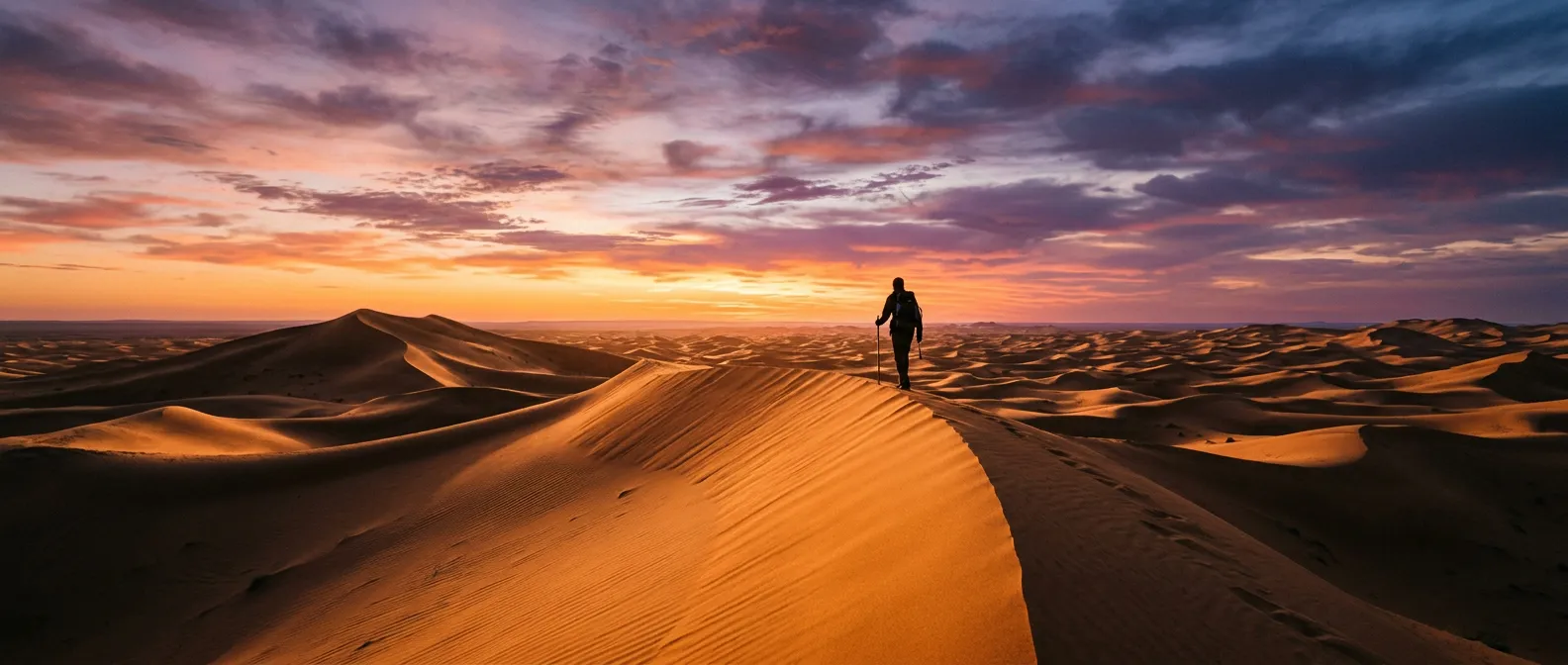
The Erg Chebbi dune field rising above the village of Merzouga is one of the world's iconic landscape photography locations. At 150 metres high and covering 50 square kilometres, these orange-red dunes change character entirely across the day -- from blue-grey pre-dawn mystery to blazing copper at midday to crimson-shadow geometry at golden hour. This workshop structures your four days around the light: early-morning camel rides to remote dune crests before sunrise, full technical instruction during the midday heat, and extended dusk sessions exploiting the raking side-light that sculpts dune ridgelines into graphic forms. Two nights are spent in a traditional luxury desert camp within the dune field.
What You Will Learn
- Long exposure desert dune photography
- Working the golden hour sequence at sunrise and sunset
- Sand texture and ridge-line composition
- Camel caravan silhouette timing and placement
- Avoiding sand contamination in camera equipment
- High dynamic range capture without HDR processing
Equipment Needed
- Wide-angle lens (16-35mm or equivalent)
- Sturdy tripod with sand spike or wide feet
- Graduated neutral density filters (two-stop and three-stop)
- Dust-sealed camera body strongly recommended
- Lens cloths and rocket blower for sand management
Sunrise camel caravan silhouette sequence from the highest accessible dune crest
Fes Artisan Portrait Workshop
Fes el-Bali (Old Medina), Tanneries, Ain Nokbi
Duration
3 days
Group Size
4 to 6 participants
Skill Level
Intermediate to Advanced
Price Range
USD 540 to 720 per person
Best Season
September to May
Fes el-Bali contains the world's oldest continuously operating university and a medieval craft economy that has functioned with minimal interruption for twelve centuries. Zellige tile-cutters, bronze engravers, leather tanners using the same dye pits documented in 12th-century manuscripts, and weavers producing brocade silks on hand-operated Jacquard looms -- all practise their trades in workshops that double as compelling portrait environments. This workshop provides workshop-owner introductions, cultural briefings on appropriate interaction, and intensive instruction on the specific photographic challenges of dark interior environments where artificial and natural light create complex mixed-colour situations.
What You Will Learn
- Environmental portrait technique in low workshop light
- Building subject trust and obtaining genuine expressions
- Tannery photography: position, angle, and timing
- Pottery and zellige workshop interior lighting
- Mixing natural and artificial light sources
- Cultural context for respectful artisan documentation
Equipment Needed
- 85mm portrait lens or 50mm on crop sensor
- 24-70mm zoom for environmental context shots
- Fast prime (f/1.4 or f/1.8) for low workshop light
- Small LED panel (optional) for supplementary fill
Pre-sunrise tannery access when morning light fills the dyeing pits from directly above
Atlas Mountain Village Photography
High Atlas, Imlil, Aït Benhaddou, Ourika Valley
Duration
4 days
Group Size
4 to 8 participants
Skill Level
All levels
Price Range
USD 680 to 920 per person
Best Season
March to May and September to November
The High Atlas Mountains south of Marrakech provide a landscape of exceptional photographic variety within a compact geographic area. Pink-mud kasbahs perch above irrigated terraces of barley and almond trees. Berber villages cling to cliff faces, their earthen walls the same colour as the geology that surrounds them. At Aït Benhaddou, a UNESCO-listed ksar of interlocking earthen towers creates one of Morocco's most photographed silhouettes at dusk. Toubkal, at 4,167 metres the highest peak in North Africa, provides dramatic mountain backdrops visible from valley floors without technical climbing. This workshop balances landscape work with Berber village documentary photography, offering participants a complete range of subjects from intimate to grand.
What You Will Learn
- Mountain landscape photography with human scale elements
- Berber village documentary photography
- Kasbah and earthen architecture in strong directional light
- Hiking with camera equipment: weight and protection
- Wide-angle landscape composition in dramatic terrain
- Snow-capped peak photography from valley floor
Equipment Needed
- Wide-angle zoom (16-35mm or 10-22mm on crop)
- Standard zoom for village documentary work
- Polarising filter essential for sky-mountain contrast
- Weather-sealed body for variable mountain conditions
- Extra batteries (cold reduces battery life significantly)
Golden-hour kasbah silhouette at Aït Benhaddou with snow-dusted Atlas peaks behind
Essaouira Coastal Light and Wind City Workshop
Essaouira Medina, Ramparts, Fishing Port
Duration
2 days
Group Size
4 to 8 participants
Skill Level
Beginner to Intermediate
Price Range
USD 280 to 420 per person
Best Season
Year-round (trade winds strongest June to August)
Essaouira's Atlantic position creates lighting conditions unlike anywhere else in Morocco. The perpetual offshore trade winds carry fine Atlantic moisture that softens and diffuses direct sunlight into a luminous, shadowless quality that portrait photographers particularly prize. The historic blue fishing boats moored in the port -- centuries-old wooden vessels painted the same deep Majorelle blue as the town's shutters -- provide colour contrast against white-washed walls and grey Atlantic water. The Skala de la Ville, a 16th-century Portuguese sea bastion with ornamental brass cannons overlooking the Atlantic, offers extraordinary sunrise shooting positions. Argan oil vendors, silver jewellery craftswomen, and Gnaoua musicians in the medina provide compelling documentary subjects.
What You Will Learn
- Atlantic coastal light and its distinctive soft quality
- Blue boat and fishing port documentary photography
- Rampart architecture in diffused ocean light
- Wind and movement in landscape and street photography
- Seagull and wildlife timing on the fishing docks
- Black-and-white conversion for coastal architecture
Equipment Needed
- 24-70mm zoom for versatile coastal work
- Telephoto (70-200mm) for port and wildlife compression
- Polarising filter for ocean-colour saturation
- UV filter to protect front element from salt spray
- Sealed camera bag for wind-blown sand and spray
Pre-dawn rampart photography as Atlantic light changes the fortification walls from grey to gold
Chefchaouen Blue City Composition Workshop
Chefchaouen Medina, Ras el-Maa, Spanish Mosque Viewpoint
Duration
2 days
Group Size
4 to 8 participants
Skill Level
Beginner to Intermediate
Price Range
USD 280 to 380 per person
Best Season
October to April (fewer tourists, cooler temperatures)
Chefchaouen's medina, painted in a continuous palette of cerulean, cobalt, and lapis blue, presents a photographic challenge that surprises every photographer who visits: how do you create contrast, depth, and interest when every surface in the frame is the same colour? This workshop teaches sophisticated monochromatic composition, the use of people and doors as colour breaks, and the specific times of day when the blue walls photograph most distinctively. The hill above town, accessible in twenty minutes on foot, provides the classic panoramic view over the blue-washed city that has made Chefchaouen one of the most photographed towns in North Africa. Workshops include a dawn walk to the Spanish Mosque viewpoint before the first tourists arrive.
What You Will Learn
- Blue-on-blue tonal composition without losing contrast
- Minimalist architecture and negative space photography
- Working with backlight and deep shadow in narrow alleys
- Overcast-day photography that suits the blue palette
- Wide-angle versus telephoto approaches to the same subject
- Cat photography in architectural context (a medina speciality)
Equipment Needed
- 24mm to 50mm prime for intimate alley work
- Wide-angle zoom for architectural elevation shots
- Graduated ND filter for bright sky above blue walls
- Small reflector for shadow fill in portrait sessions
Dawn panoramic session from the Spanish Mosque viewpoint with empty alleys below
Night Sky and Astrophotography in the Sahara
Erg Chebbi Desert, Merzouga (remote dune locations)
Duration
3 nights (combined with desert landscape days)
Group Size
4 to 6 participants
Skill Level
Intermediate to Advanced
Price Range
USD 920 to 1,300 per person (including desert camp accommodation)
Best Season
November to February (new moon phases)
The Sahara near Merzouga is among the most accessible Class 2 dark-sky locations on Earth. On moonless nights between November and February, the Milky Way's core rises high enough above the horizon to photograph in its full splendour against a sky that contains more stars than most photographers from light-polluted cities have ever seen. The dune landscape provides ready-made foreground subjects: camel silhouettes, the curved ridgeline of an orange dune crest, a traditional tent glowing with warm interior light. This workshop blends three evening/night sessions with two daytime landscape sessions, and includes a dedicated Lightroom post-processing tutorial focused specifically on the noise management and colour grading techniques that night photography requires.
What You Will Learn
- Milky Way planning and star trail calculations
- Long-exposure desert starscape technique
- Foreground integration with night sky compositions
- Light-painting desert dunes and kasbah elements
- Star tracker equipment setup and polar alignment
- Post-processing night sky images with Lightroom and Photoshop
Equipment Needed
- Full-frame or large crop sensor camera with strong high-ISO performance
- Wide-angle fast prime (f/2.8 or faster -- f/1.4 to f/2 preferred)
- Sturdy tripod -- critical for multi-minute exposures
- Star tracker optional but produces exceptional results
- Red headlamp to preserve night vision
- Extra batteries -- cold desert nights reduce capacity significantly
Three-hour moonless Milky Way core session from a remote dune with light-painting foreground
Documentary Storytelling in Morocco
Marrakech, Fes, and Atlas Villages (multi-location)
Duration
7 days
Group Size
4 to 6 participants
Skill Level
Intermediate to Advanced
Price Range
USD 1,600 to 2,200 per person
Best Season
October to April
Documentary photography is not about capturing isolated beautiful images -- it is about constructing a narrative that conveys place, time, and human experience to someone who has never been there. This seven-day intensive treats Morocco as a documentary subject of exceptional richness, guiding participants through project development, subject identification, systematic shooting, editing, and sequencing. Participants develop an individual project around a theme they select on day one -- a craft tradition, a neighbourhood, a food culture, a family business -- and build toward a coherent, publishable photo essay by day seven. Nightly group editing critiques are a core component. The workshop includes relationships with subjects in Marrakech and Fes that workshop guides have cultivated over years, providing access that independent photographers cannot arrange.
What You Will Learn
- Documentary project development and narrative structure
- Editing a coherent photo essay from 1,000 frames
- Subject access, trust-building, and ethical documentation
- Caption writing and contextual research
- Magazine and editorial photography standards
- Submitting work to stock agencies and photo editors
Equipment Needed
- Two camera bodies (essential for multi-day documentary work)
- 24-70mm and 70-200mm zoom combination recommended
- Small prime (35mm or 50mm) for discreet street work
- Laptop for nightly editing sessions
- Portable hard drives for redundant backup
Seven-day project development resulting in an edited photo essay of 10 to 15 publishable images
Workshop Types
From half-day medina walks to two-week photographic expeditions -- choose the format that matches your time, budget, and learning objectives.
Half-Day Photography Walk
A structured walk through a medina, port, or market with a professional guide who identifies photographic opportunities, provides shooting instructions, and facilitates subject interactions. No prior photography experience required. Suitable for smartphone photographers through to DSLR users.
Best For
First-time visitors who want guided photographic orientation
Multi-Day Intensive
Structured days balancing instruction, guided shooting, and group critique sessions. Participants see dramatic improvement in their technical skills and compositional eye over the course of the intensive. Accommodation and some meals are typically included.
Best For
Photographers who want significant skill development with sustained practice
Private Mentoring
One-to-one or small-group mentoring with a professional photographer tailored entirely to your current skill level, equipment, and photographic objectives. Itinerary, locations, and instruction content are built around your requirements before departure.
Best For
Experienced photographers seeking personalised instruction aligned to specific goals
Group Photography Expedition
A fully organised multi-region photography tour covering Morocco's major photographic environments: imperial cities, mountain villages, Sahara desert, and Atlantic coast. All logistics, accommodation, transport, and instruction are included. Participants need only bring their cameras.
Best For
Photographers seeking a complete Morocco experience with photographic structure throughout
Photographer's Gear Guide
What to bring, what to rent locally, and how to protect your equipment in Morocco's varied environments.
Essential Kit for Morocco Photography
A versatile zoom covering 24mm to 70mm serves the widest range of Morocco photography situations -- medina streets, portraits, architectural interiors, and market close-up work. A wide-angle zoom in the 16-35mm range becomes essential for Sahara landscapes, mountain panoramas, and the tight alley compositions of Fes and Chefchaouen. A telephoto in the 70-200mm range provides compression for portraits, isolates architectural details across busy streets, and reaches wildlife subjects in coastal and mountain environments. Fast primes (f/1.4 to f/2.8) are invaluable for the low workshop light of medina craft studios.
What to Rent Locally
Marrakech has several well-stocked camera rental operations near the Gueliz district that carry major brands including Canon, Nikon, Sony, and Fujifilm. Lens rentals are particularly worthwhile for specialised items you might not own: tilt-shift lenses for architectural correction, long telephoto primes for desert wildlife, or fisheye lenses for souk ceiling shots. Tripods and filters are also available for rental, which saves significant checked baggage weight. Book rentals at least one week in advance during peak season (October to March).
Camera Shops in Marrakech and Casablanca
In Marrakech, the Gueliz district and the area around Mohamed V Avenue contain several electronics and camera retailers. Photo Mogador on Avenue Mohammed V stocks filters, memory cards, cleaning equipment, and basic accessories. In Casablanca, the twin towers mall (Casablanca Twin Center) and the Maarif district have larger electronics retailers carrying mainstream camera accessories. For professional equipment purchases or significant repairs, Casablanca is more reliable than Marrakech. Note that prices for branded photography equipment in Morocco are generally ten to twenty percent higher than European or North American retail prices due to import duties.
Protecting Equipment in Moroccan Environments
Sand is the greatest threat to camera equipment in Morocco. The Sahara poses obvious risks, but desert winds carry fine particles that reach the Atlas Mountains and even coastal towns. In windy conditions, change lenses inside a closed vehicle, hotel room, or the shelter of a sand bag -- never in open desert. A UV filter on every lens costs little and protects front elements worth far more. Anti-static sensor cleaning wipes remove the charged particles that cling to sensors after sandy environments. Humidity is a secondary concern in the north and along the Atlantic coast -- silica gel packets in your camera bag absorb moisture overnight.
Photography Ethics
How to photograph Morocco with the respect that transforms encounters from extractions into genuine exchanges.
Consent and Compensation
In Moroccan culture, photographing an individual without permission is considered disrespectful and in some contexts insulting. The workshop approach to consent involves making genuine human contact first -- greeting someone, exchanging a few words, showing interest in their work -- before raising a camera. When you ask permission and someone declines, honour that immediately without argument. When people allow you to photograph them, a genuine human exchange is more valuable than money, but in commercial or souk contexts where someone has posed or stopped their work for you, a small payment (typically 5 to 20 Moroccan dirhams) is appropriate and appreciated.
Religious Sites and Prayer Times
Non-Muslims are not permitted inside most Moroccan mosques (the Hassan II Mosque in Casablanca is a notable exception). Photographing through open mosque doors or from elevated positions overlooking mosque courtyards is generally acceptable but should be done with sensitivity. During the call to prayer (five times daily), medinas quiet and worshippers move toward the mosque -- this is a time to lower your camera and observe respectfully rather than photograph intensively. Religious celebrations and festivals may have specific photography restrictions that workshop guides will communicate in advance.
Children
The photography of children requires heightened ethical care in any country. In Morocco, photographing children in medinas and markets is common but should always occur with parental awareness and consent when parents are present. Workshop guides help navigate these situations. Photographs of children should never be taken in ways that could exploit or misrepresent their circumstances. If you intend to publish or sell photographs that include recognisable children, signed model releases are legally and ethically required -- guides can assist with this paperwork for subjects willing to participate.
Militarily and Politically Sensitive Locations
Morocco's border regions, military installations, government ministries, royal palace exteriors, and certain infrastructure (dams, power stations, airports beyond designated photography zones) are restricted or prohibited subjects. Some of these restrictions are posted; others are understood locally. Workshop guides are aware of all restrictions and will direct you away from situations that could cause problems. When in doubt, ask before photographing. Penalties for photographing restricted sites can include confiscation of equipment and detention for questioning.
Best Light by Season and Region
Morocco's regions each have a distinct light character. Knowing when and where to be positioned makes the difference between a good frame and an exceptional one.
| Region | Best Light Window | Optimal Seasons | Photographer Notes |
|---|---|---|---|
Marrakech Medina | First hour after sunrise and final 90 minutes before sunset; Djemaa el-Fna at dusk | October to March (lower sun angle creates longer golden hour) | Medina alleys are often in deep shadow all day -- harness reflected light from whitewashed walls for ambient fill. Avoid shooting tannery districts in midday summer heat. |
Sahara Desert | Fifteen minutes before and after sunrise; thirty minutes either side of sunset | October to February (lower sun angle sculpts dunes more dramatically) | Midday desert photography is challenging but not impossible -- use monochrome conversion to exploit contrast between orange sand and white sky. |
Fes Medina | Tanneries: 9am to 11am when sunlight hits vat interiors from directly above | September to May | Fes medina alleys are narrower than Marrakech -- light patches move fast. Identify your composition before the light arrives and be ready to shoot immediately. |
Atlas Mountains | Two hours after sunrise for soft mountain light; blue hour at dusk for kasbah silhouettes | March to May (wildflowers); October to November (autumn colour) | Mountain weather changes rapidly -- plan for overcast conditions and embrace diffused light for Berber village documentary work. |
Essaouira | Overcast days provide ideal shadowless light; clear mornings for rampart golden hour | Year-round (trade winds reduce summer humidity) | The perpetual Atlantic diffusion means Essaouira lacks harsh shadows even at midday -- ideal for portrait work at any time. |
Chefchaouen | Pre-sunrise blue hour when walls glow and streets are empty; overcast mornings | October to April (winter fog creates atmospheric street scenes) | Direct midday sun creates blown highlights on white walls and extreme contrast within the blue palette -- prefer overcast or shade. |
Workshop Price Comparison
All prices are per-person estimates that vary based on accommodation grade, group size, and seasonality.
| Workshop | Duration | Group Size | Price Per Person | Typically Includes |
|---|---|---|---|---|
Half-Day Photography Walk | 3 to 4 hours | 4 to 8 | USD 80 to 150 | Professional guide, location access, basic instruction |
Full-Day Workshop | 8 to 10 hours | 4 to 8 | USD 150 to 300 | Guide, lunch, transport between locations |
Marrakech Street Intensive (3 days) | 3 days | 4 to 8 | USD 480 to 650 | Instruction, riad accommodation, medina access |
Sahara Desert Workshop (4 days) | 4 days | 4 to 10 | USD 780 to 1,100 | Desert camp nights, transport, camel trek, instruction |
Astrophotography Expedition (3 nights) | 3 to 4 nights | 4 to 6 | USD 920 to 1,300 | Desert camp accommodation, transport, Lightroom tutorial |
Documentary Storytelling Intensive (7 days) | 7 days | 4 to 6 | USD 1,600 to 2,200 | Multi-city transport, mixed accommodation, nightly critiques |
Private Mentoring (per day) | 1 day (customisable) | 1 to 3 | USD 300 to 600 | Fully personalised instruction, customised locations |
Full Morocco Expedition (10 to 14 days) | 10 to 14 days | 6 to 12 | USD 2,500 to 5,500 | All accommodation, transport, meals, instruction, permits |
Five-Day Photography Expedition Itinerary
Marrakech through the Atlas Mountains to the Sahara Desert -- the core Morocco photography journey covering five landmark environments.
Marrakech
Marrakech Arrival and Medina Orientation
Photographic Focus: Low-light street photography, crowd management, ambient dusk exposure
- Afternoon: Riad check-in, camera settings review, group introductions
- Late afternoon: Djemaa el-Fna pre-dusk positioning and composition planning
- Dusk: First shoot -- square filling with performers, musicians, and juice stalls
- Evening: Group review of the day's images with workshop leader
Marrakech
Marrakech Souk and Artisan Quarter Deep Dive
Photographic Focus: Environmental portraiture, craft documentation, colour composition
- Pre-dawn: Rooftop positions above the souk for sunrise light on minarets
- Morning: Guided souk photography through spice, textile, and copper quarters
- Midday: Indoor instruction session -- colour theory and Morocco's visual palette
- Afternoon: Artisan workshop visits -- coppersmith, leather goods, and carpet weaving
- Dusk: Djemaa el-Fna second session with refined techniques from Day 1 critique
Tizi n'Tichka, Aït Benhaddou
Atlas Mountain Drive and Village Photography
Photographic Focus: Landscape-to-detail scale range, earthen architecture in strong light
- Early morning: Departure through Tizi n'Tichka mountain pass
- Mid-morning: High Atlas landscape photography stops along the pass road
- Noon: Aït Benhaddou ksar arrival -- architectural photography instruction
- Afternoon: Aït Benhaddou interiors and resident portrait sessions
- Dusk: Extended golden-hour kasbah shooting with mountain backdrop
- Overnight: Kasbah guesthouse near Aït Benhaddou
Ouarzazate to Erg Chebbi, Merzouga
Desert Arrival and Sahara First Light
Photographic Focus: Landscape scale and proportion, golden-hour dune geometry
- Morning: Ouarzazate film studios photography stop
- Afternoon: Drive through Draa Valley with roadside date palm photography
- Late afternoon: Merzouga desert camp arrival and equipment setup
- Dusk: First dune shoot -- golden-hour ridgeline and shadow composition
- Night: Optional night sky observation and Milky Way introduction (weather permitting)
Erg Chebbi Dunes
Sahara Sunrise, Astrophotography, and Departure
Photographic Focus: Sunrise sequence timing, camel silhouette composition, image selection and editing
- Pre-dawn (4:30am): Camel ride to high dune crest for sunrise positioning
- Sunrise: Extended golden-hour and blue-hour shooting on remote dune crest
- Morning: Lightroom post-processing tutorial back at camp
- Midday: Departure review and portfolio selection session
- Afternoon: Return transfer to Marrakech or Ouarzazate airport
Post-Processing and Editing
Workshops include Lightroom sessions tailored to Morocco's specific colour, light, and tonal challenges.
Lightroom Editing for Moroccan Colours
Morocco's saturated spice-market palette, terracotta earthen architecture, and vivid blue-city tones require specific Lightroom handling. Workshop post-processing sessions cover HSL adjustments for preserving the warmth of sandy kasbahs while preventing orange skin tones in portraits, blue hue-shift for Chefchaouen's distinctive palette, and the targeted use of luminance adjustments to control the blown highlights common in high-contrast desert photography.
Night Sky Post-Processing
Astrophotography workshops include dedicated Lightroom and Photoshop editing sessions covering noise reduction at high ISO, Milky Way colour grading (bringing out the natural teal-magenta colour gradient of the galactic core), and the layer-masking techniques required to blend a tracked sky with an untracked foreground. Adobe Camera Raw noise reduction, Topaz DeNoise AI, and Luminar AI sky-enhancement tools are all covered.
Documentary Photo Essay Editing
Documentary workshops include a structured editing methodology: contact sheet review, technical cull, thematic selection, sequencing for narrative flow, and final caption writing. Participants learn to edit their own work ruthlessly -- distinguishing between the images they are emotionally attached to and the images that serve the story best. Final essay presentation to the group on the last evening provides practical experience receiving and responding to editorial feedback.
Street Photography Black and White Conversion
Many of Morocco's strongest street photographs work as powerfully in black and white as in colour. Workshop sessions on monochrome conversion cover the Silver Efex Pro approach to tonal mapping, the use of colour-filter simulation (red filter for darkened skies, orange for skin tone enhancement) within the black-and-white mix panel, and the specific contrast and grain treatments that suit different photographic subjects from architectural geometry to atmospheric portraiture.
Building Your Portfolio Through Morocco
A Morocco photography workshop produces more than a hard drive of images. The environments and subjects you encounter -- the pre-dawn medina, the golden-hour dune crest, the tannery worker whose portrait you negotiated and lit -- become reference points that permanently expand your understanding of what photography can do when it engages with extraordinary material.
For photographers developing professional portfolios, Morocco images carry immediate editorial currency. Magazine editors, travel content platforms, and stock agencies actively seek high-quality Morocco content in several specific categories: artisan documentary, Sahara landscape, and Chefchaouen architectural photography are perennial performers. A well-edited portfolio of 20 to 30 strong Morocco images can generate licensing revenue that offsets workshop costs over time.
For photographers growing in creative practice rather than building commercial portfolios, Morocco provides what most home environments cannot: subjects of genuine depth that reward sustained attention. The artisan relationships developed during a three-day Fes workshop often continue after the photographer returns home -- through correspondence, return visits, and the slow deepening of documentary projects that began with a single portrait in a copper workshop.
20 to 30
Publishable images from a 5-day expedition
7 days
Minimum for documentary storytelling project
4 to 8
Optimal group size for learning and access
Frequently Asked Questions
What is the best time of year to attend a photography workshop in Morocco?
October through April offers the most favorable light and temperatures for photography workshops across all regions. Spring delivers lush green Atlas Mountain landscapes and wildflowers. Autumn provides warm golden light, comfortable temperatures, and less crowded medinas. December and January are ideal for Sahara astrophotography.
Do I need professional-level equipment for a Morocco photography workshop?
No. Morocco photography workshops welcome photographers using everything from entry-level mirrorless cameras to full-frame professional systems. A camera with manual mode control, at least one versatile zoom lens, and a sturdy tripod for low-light and astrophotography work will serve you well for most workshops.
Is it safe to photograph in Moroccan medinas and souks?
Moroccan medinas are generally safe for photography, but discretion and respect are essential. Always ask permission before photographing individuals. In souks, acknowledge vendors before pointing a lens in their direction. Workshop guides know which areas welcome cameras and which require a more discreet approach.
How small are the group sizes in Morocco photography workshops?
Group sizes vary by workshop type. Half-day street photography walks typically accept four to eight participants. Multi-day intensives are capped at six to ten participants. Private mentoring sessions accommodate one to three photographers for fully customized instruction.
What skill level is required for Morocco photography workshops?
Workshops exist for every skill level. Beginner workshops focus on camera fundamentals, light reading, and composition basics. Intermediate workshops concentrate on storytelling and portrait technique. Advanced workshops and private mentoring sessions target portfolio development and fine art landscape photography.
How much do Morocco photography workshops cost?
Half-day photography walks typically cost USD 80 to 150 per person. Full-day workshops run USD 150 to 300. Multi-day intensive workshops cost USD 600 to 1,800. Private one-to-one mentoring runs USD 300 to 600 per day. Five-day photography expeditions with accommodation and instruction included range from USD 1,800 to 3,500 per person.
Can I photograph in the Sahara Desert at night for astrophotography?
Yes. Morocco's Sahara near Merzouga offers Bortle Class 2 or 3 dark skies where the Milky Way is clearly visible and photographable in stunning detail. New moon periods between November and February provide the most dramatic astrophotography conditions.
Are Morocco photography workshops suitable for solo travelers?
Morocco photography workshops are particularly well suited to solo travelers. Small-group workshops provide built-in companionship with fellow photography enthusiasts. The structured itinerary removes logistical complexity, and workshop guides provide cultural context and language support that helps solo photographers access subjects that would be difficult to find alone.
Related Guides
Plan Your Morocco Photography Journey
Our travel designers can build a bespoke photography itinerary around your preferred workshops, accommodation standards, and travel dates. Inquire today and receive a personalised proposal within 24 hours.
Chat with our team on WhatsApp -- +212 701 664 704