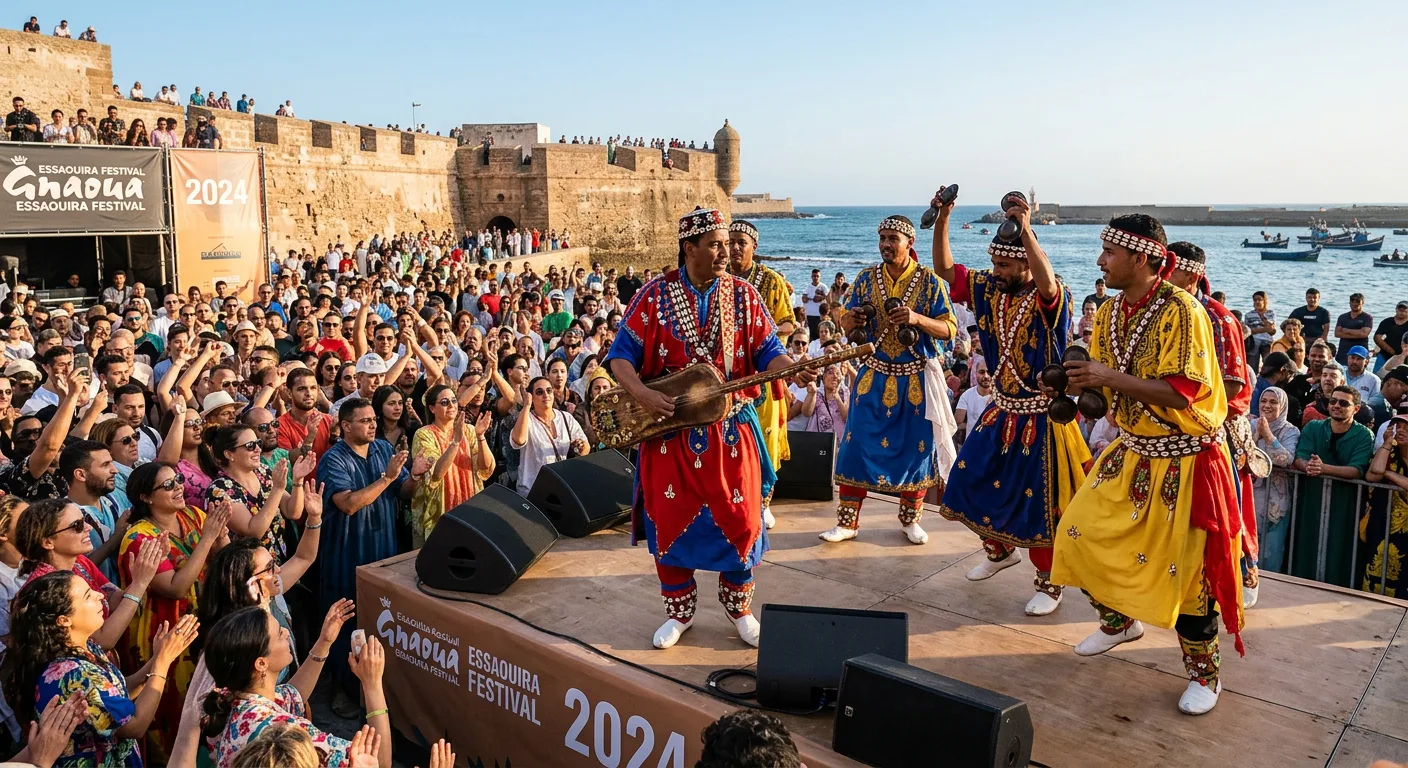
Morocco's Music:
Ancient Voices, Living Traditions
Morocco is one of the world's richest musical cultures. At least six distinct traditions coexist -- some over a thousand years old, some born from trans-Saharan trade, some carried from Moorish Spain.
Each tradition has its own instruments, occasions, and spiritual dimension. This is the complete guide to understanding what you are hearing.
Morocco's Major Musical Traditions
Six distinct musical worlds, each with its own history, instruments, social function, and spiritual dimension. Together they form one of the most diverse and ancient musical cultures on Earth.
Gnawa
كناوةSub-Saharan African slaves brought to Morocco via trans-Saharan trade. Evolved over centuries into a distinct Moroccan tradition inscribed on the UNESCO Intangible Cultural Heritage list in 2019.
Trance music. Repetitive, hypnotic, rhythmically complex. Originally used for healing ceremonies called lila -- all-night rituals for the exorcism of spirits and healing of the sick. The music builds in waves of increasing intensity, producing trance states that practitioners believe facilitate spiritual healing and purification.
Guembri (three-stringed bass lute, played by the maalem or master musician), krakeb (heavy metal castanets creating interlocking polyrhythmic patterns), tbel (large drums).
Essaouira (Gnawa and World Music Festival in June, and year-round in dedicated performance venues), Marrakech (Djemaa el-Fna evening musicians), Khamlia village near Merzouga.
The lila ceremony is an all-night ritual where Gnawa music is used for healing. Each section invokes different spiritual entities through specific melodies and rhythms. Tourists can sometimes observe (not participate in) these ceremonies through respectful arrangement.
Gnawa has fused with jazz, reggae, and hip-hop. The recordings of Maalem Mahmoud Guinia are considered foundational to the genre internationally. Artists like Hassan Hakmoun brought Gnawa-jazz fusion to New York audiences.
Andalusian Classical Music
الموسيقى الأندلسيةBrought by Moorish and Jewish refugees from Andalusia (Spain) in 1492. When the Moors were expelled, they carried eight centuries of musical sophistication with them. Morocco preserved this tradition when it was lost in Spain itself.
Complex classical orchestral music. Organized into elaborate compositional suites called nuba, each moving through distinct rhythmic modes and melodic frameworks. Extremely refined, with a written tradition. Each nuba corresponds to a specific time of day and emotional character.
Oud (pear-shaped lute with no frets), rabab (bowed spike fiddle with a haunting, reedy timbre), qanun (trapezoidal plucked zither), darbouka (goblet drum), violin and other chamber instruments.
Conservatories and cultural centers in Fes, Rabat, and Tetouan. Special concerts during cultural festivals, particularly the Festival of World Sacred Music in Fes.
Three cities have distinct schools: the Fes school (Gharnati style), the Rabat school, and the Tetouan school. Each preserved different pieces of the original repertoire. Of the original twenty-four nuba, eleven survive in the Moroccan tradition.
Morocco has one of the world's great archives of medieval Islamic music, still performed today. Andalusian music is Morocco's equivalent of European classical chamber music -- refined, intellectual, and deeply moving.
Berber / Amazigh Music
Indigenous to North Africa. Predates the Arab arrival by thousands of years. The Amazigh people have inhabited Morocco since before recorded history, and their musical traditions are among the oldest living musical cultures on Earth.
Different regional styles -- Middle Atlas, High Atlas, Anti-Atlas, and Rif Mountains each have distinct traditions. Generally communal, participatory, and tied to seasonal celebrations, harvests, weddings, and religious occasions. Call-and-response singing is central.
Bendir (large frame drum with a deep resonance), tidinit (plucked lute), imzad (one-stringed bowed fiddle -- traditionally a women's instrument), and voice (often call-and-response between a lead singer and group).
Imilchil festival (September -- Berber wedding festival in the Atlas). Rural moussem (local saints' day festivals). Some Atlas mountain villages still have regular communal music gatherings.
The Ahidus is a Middle Atlas Berber tradition where men and women dance together in large circles, singing in unison and moving in rhythmic synchronization. A rare expression of gender mixing in traditional Moroccan culture. The Ahwash is a similar but distinct dance tradition from the High Atlas and Anti-Atlas.
Contemporary Amazigh musicians blend traditional forms with modern instrumentation. The Timitar Festival in Agadir (July) is the largest celebration of Amazigh musical culture.
Chaabi
شعبيTwentieth-century urban Morocco. A fusion of Berber, Andalusian, and African elements created for mass entertainment. Chaabi literally means "popular" or "of the people."
Upbeat, danceable, electric instruments mixed with traditional percussion. The pop music of Morocco in the mid-twentieth century, and still the default music at celebrations, weddings, and cafes. Lyrics often deal with love, daily life, and social commentary in Darija (Moroccan Arabic).
Electric guitar, synthesizer, darbouka, bendir, violin, and traditional hand drums alongside modern amplification.
Cafe performances throughout Morocco. Wedding musicians. Street festivals. Chaabi is the soundtrack of everyday Moroccan social life -- it is heard in taxis, shops, and homes across the country.
Chaabi is not a single genre but a broad category encompassing many regional styles. It is the most commonly heard music in Morocco and the genre most Moroccans would identify as "our music."
Modern Chaabi has absorbed electronic production, auto-tune, and hip-hop influences while retaining its essential character as danceable, accessible, socially engaged popular music.
Aita
Rural Morocco, particularly the Atlantic plains (the Chaouia region near Casablanca). One of Morocco's oldest sung poetry traditions.
Sung poetry combining storytelling, lament, and celebration. Traditionally associated with women performers called chikhat (singular: chikha), who combine singing, dancing, and poetic improvisation. The lyrics often deal with love, loss, social commentary, and the hardships of rural life.
Voice (the primary instrument), bendir, kamanja (violin), and sometimes loutar (a long-necked lute). The voice carries the melodic and poetic weight.
Some festivals and rural celebrations include aita performances. The tradition is strongest in the Chaouia, Doukkala, and Abda regions of the Atlantic coastal plains.
The chikhat were historically marginal figures -- women who performed at celebrations and public gatherings at a time when female public performance was socially controversial. Their art preserved oral poetry and social history that might otherwise have been lost. The tradition is sometimes controversial in conservative contexts.
Aita has influenced many modern Moroccan musical forms. Some contemporary artists are working to preserve and revitalize the tradition while bringing it to wider audiences.
Sufi Music (Sama)
Sufi orders (tariqas) throughout Morocco. Devotional music developed within the mystical Islamic tradition for the purpose of spiritual elevation and closeness to the divine.
Devotional music for spiritual elevation. Can include trance states, dhikr (repeated invocations of the names of God), and ecstatic physical movement. The music is not performed for entertainment but as a form of prayer and spiritual practice.
Voice (primary), bendir, tbel, and sometimes oud. The human voice carrying sacred text is the essential element. Instrumental accompaniment supports the vocal invocations.
The Hamadsha and Aissawa brotherhoods perform publicly at certain moussem (festivals). The mausoleum of Moulay Idriss in Fes has regular Sufi music gatherings. The Festival of World Sacred Music in Fes features Sufi performances.
These are sacred ceremonies, not entertainment. Observers should be respectful, quiet, and unobtrusive. Photography is generally not appropriate during active devotional practice. Ask your guide for appropriate behavior protocols.
Sufi music continues as a living devotional practice in Morocco's many tariqas. Some contemporary artists have brought Sufi musical elements into secular contexts, but the core tradition remains firmly rooted in spiritual practice.
The Instruments of Morocco
Each instrument carries the character of its tradition. Understanding what you are hearing -- and seeing -- deepens the experience of live Moroccan music.
| Instrument | Type | Tradition |
|---|---|---|
| Guembri | Three-string bass lute | Gnawa |
| Oud | Pear-shaped lute (no frets) | Andalusian, Classical |
| Rabab | Bowed spike fiddle | Andalusian, Berber |
| Bendir | Frame drum | Berber, Sufi |
| Darbouka | Goblet drum | All traditions |
| Krakeb | Metal castanets | Gnawa |
| Qanun | Trapezoidal zither | Andalusian |
| Ghaita | Double-reed wind instrument | Berber ceremonies |
Guembri
Deep, thumping, rhythmic -- a bass pulse that drives the entire Gnawa ensemble. The carved wooden body produces a resonance closer to a bass guitar than to any other lute.
Oud
Warm, complex, melodic. The absence of frets allows continuous pitch bending and ornamentation. The oud is the ancestor of the European lute.
Rabab
Haunting, reedy. A single-stringed or two-stringed bowed instrument that produces a distinctive nasal tone capable of great emotional expression.
Bendir
Deep resonance. A large circular frame drum with snares on the inside surface that buzz against the skin, adding a characteristic rattle to the fundamental tone.
Darbouka
Versatile rhythm instrument. Capable of both deep bass tones (played in the center) and sharp, cutting high tones (played on the rim). The most ubiquitous percussion instrument in Moroccan music.
Krakeb
Sharp, metallic, interlocking rhythmic patterns. Pairs of heavy iron castanets played by the chorus of Gnawa musicians to create complex polyrhythmic textures beneath the guembri.
Qanun
Bright, harp-like cascades of notes. A plucked string instrument played horizontally on the lap, capable of rapid arpeggios and delicate melodic ornamentation.
Ghaita
Piercing, designed for outdoor use. Heard across Morocco at festivals, processions, and celebrations. Its powerful volume carries over drums and crowd noise.
Festivals: Where to Experience Music Live
Morocco's music festivals are among the finest in Africa and the Arab world. Several feature free outdoor concerts in extraordinary historic settings.
Gnawa and World Music Festival
One of Africa's great music festivals. Free outdoor concerts across the medina and along the ramparts. Gnawa masters perform alongside international jazz, blues, and world music artists. The festival transforms Essaouira into an open-air concert venue for four days.
Festival of World Sacred Music
Sufi, Andalusian, and classical sacred music from Morocco and around the world. Concerts are held in extraordinary medina venues -- courtyards of historic palaces, the Bab Makina plaza, and intimate garden settings. One of the most atmospheric music festivals anywhere.
Timitar Festival
Amazigh (Berber) music and international world music. One of the largest music festivals in Morocco by attendance. Celebrates Amazigh cultural identity through music, with free concerts across multiple stages in the city center.
Jazz au Chellah
Jazz meets Andalusian music in the Roman and medieval ruins of Chellah. An intimate festival that brings Moroccan and international jazz musicians together in one of the most evocative concert settings in the country -- ancient stone walls, gardens, and stork nests overhead.
Moussem of Moulay Idriss
A major annual pilgrimage and festival at the tomb of Moulay Idriss I, the founder of the first Moroccan dynasty. Extensive traditional music, including Sufi brotherhoods, Berber groups, and processional music. The atmosphere is deeply devotional and culturally rich.
Where to Hear Music Daily
You do not need to plan your trip around a festival. Moroccan music is a living, daily presence in markets, cafes, squares, and religious spaces. Knowing where to listen is the key.
Djemaa el-Fna, Marrakech
Gnawa musicians performing most evenings in the great square. Master musicians play for tips, creating impromptu concerts that can last hours. The sound of the guembri and krakeb against the backdrop of the square's chaos is one of Morocco's defining sensory experiences.
Joutia Market Area, Marrakech
Chaabi musicians performing popular songs. Less tourist-oriented than the main square, these performances are for Moroccans and offer a more authentic glimpse of everyday musical culture.
Sufi Lodge (Zawiya) Visits
Some local guides can arrange visits to Sufi lodges where devotional music is practiced. These are not tourist performances but active spiritual gatherings. Respectful observation is sometimes possible through proper introduction.
Medina Cafes
Recorded classical Andalusian music is common background in traditional cafes throughout Fes and Rabat. Some upscale establishments feature live musicians on weekends. The combination of mint tea, zellige tilework, and classical Moroccan music is a complete sensory experience.
Modern Morocco
The fusion is extraordinary -- Moroccan artists blending Gnawa with jazz, hip-hop with Darija lyrics, electronic music with Berber vocals. Moroccan music is experiencing a global renaissance.
Nass El Ghiwane
Folk-Rock FusionOften called "the Rolling Stones of Africa." Formed in the 1970s in Casablanca, they fused Gnawa, Chaabi, and rock influences into socially engaged music that became the soundtrack of post-independence Morocco. Their acoustic, raw sound remains influential.
Maalem Mahmoud Guinia
Traditional GnawaThe most internationally renowned Gnawa master musician. His recordings are considered the foundational documents of the genre. Collaborated with Pharoah Sanders, Randy Weston, and other jazz luminaries.
Hassan Hakmoun
Gnawa-Jazz FusionBrought Gnawa music to New York and fused it with jazz, funk, and world music. His work introduced Gnawa to Western audiences and demonstrated the music's compatibility with modern improvised forms.
Buying Instruments
Guembri
Buy in Marrakech (Souk el-Kebir has instrument shops specializing in traditional Moroccan instruments) or Essaouira, where the Gnawa tradition is strongest and the instrument-makers understand the requirements of professional musicians.
Oud
Specialized luthiers in Fes and Marrakech produce instruments ranging from student-quality to professional-grade. A well-made Moroccan oud is a legitimate musical instrument and a beautiful object. Ask your guide to introduce you to a reputable maker.
Bendir and Darbouka
Available throughout Morocco in varying quality. The souks of Marrakech and Fes have the widest selection. Listen to the instrument before buying -- the quality of the skin and the resonance of the body vary enormously.
Essential Recordings
These recordings provide an essential introduction to Moroccan music traditions. Listen before your trip to train your ear for what you will encounter live.
Maalem Mahmoud Guinia -- foundational Gnawa recordings (multiple albums)
Nass El Ghiwane -- classic Moroccan folk-rock (1970s recordings)
Hassan Hakmoun -- Gnawa-jazz fusion
Orchestra of Fes -- Andalusian classical nuba recordings
Master Musicians of Joujouka -- Rif mountain trance music
Experience Morocco's Living Musical Heritage
From Gnawa trance ceremonies to Andalusian classical orchestras, our guides connect you with Morocco's musicians, festivals, and living traditions.
Plan Your Musical Journey