What is a minaret and why do Moroccan mosques have them?
The short answer
Our team's answerA minaret is the tall tower attached to a mosque, from which the call to prayer is announced five times a day. Morocco's minarets are typically square rather than round, often beautifully tiled, and the most famous — the Koutoubia in Marrakech — is a national landmark.
Serenity Morocco Expert Team
Travel Designer · Staff · June 2026
Question
The full answer
A common question when planning a trip to Morocco, answered honestly by our travel designers.
A minaret is the tower you see rising beside every Moroccan mosque, and it serves one simple purpose: it is the high point from which the call to prayer carries out over the town. What makes Moroccan minarets so recognisable is their shape — square-sided, in the Andalusian and North African tradition, rather than the slender round towers you find further east. Once you have noticed this, you will spot it everywhere.
For travellers, minarets are wonderful navigation aids and orientation points. Lost in the tangle of a medina, we tell guests to look up: the tallest minaret is usually the main mosque, and the main mosque is usually near the heart of things. The Koutoubia in Marrakech and the Hassan II minaret in Casablanca double as landmarks you can steer your whole day around.
A respectful note worth knowing: in Morocco, working mosques are generally not open to non-Muslim visitors, so you admire the minaret and the courtyard from outside rather than entering. There are exceptions — the vast Hassan II Mosque in Casablanca offers guided tours to everyone, and it is genuinely spectacular, so I almost always build it into a Casablanca itinerary.
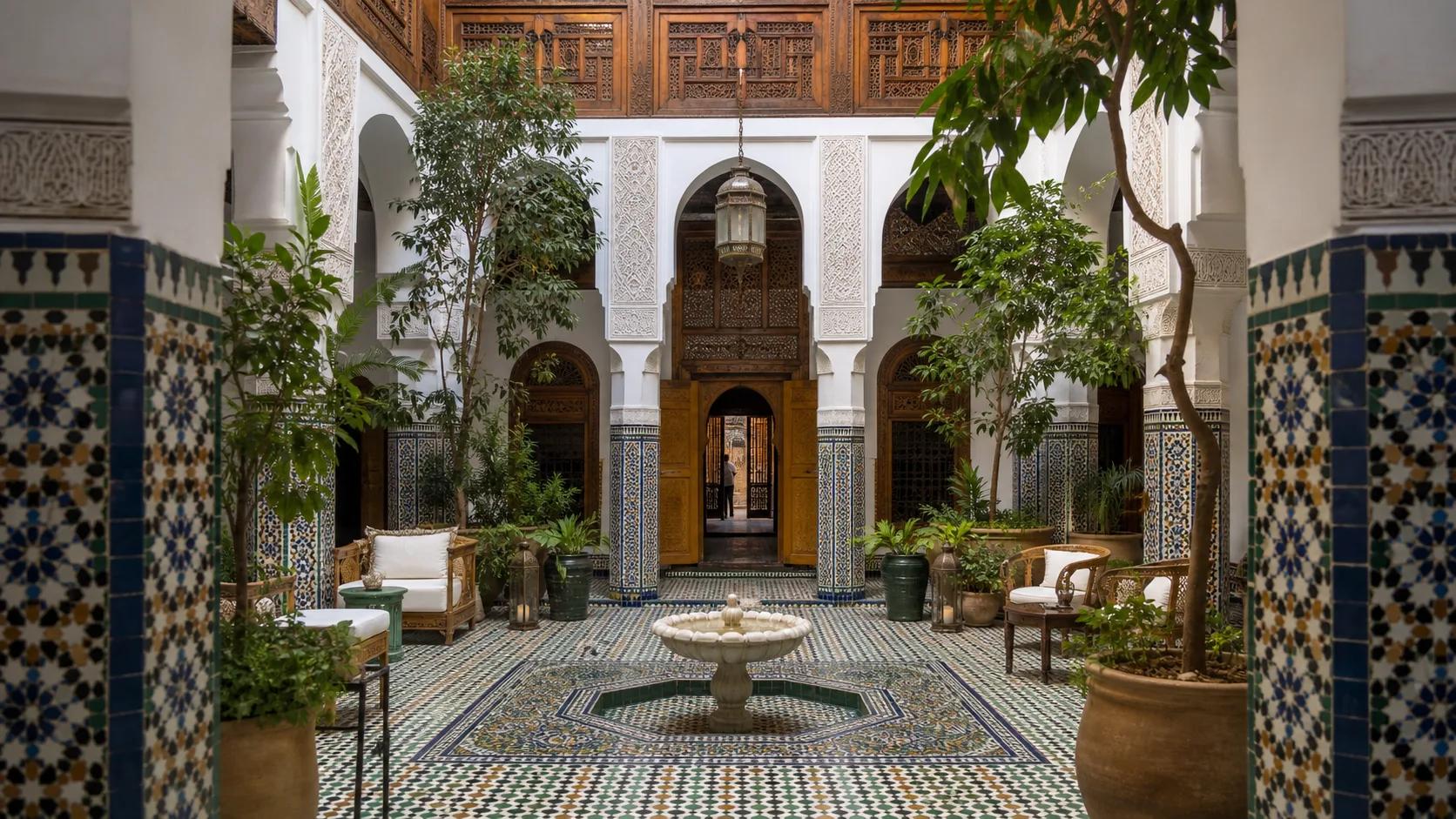
The tilework, brickwork and carved plaster on a fine minaret are an architecture lesson in themselves, telling you the era and the dynasty that built it. Standing at the foot of the Koutoubia as the light turns gold and the muezzin's call begins is a moment guests describe to me long after they've gone home — proof that a tower can hold an entire memory of a country.
- minaret
- mosque
- architecture
- koutoubia
- culture
- glossary
Serenity Morocco Expert Team — Travel Designers, Serenity Morocco Tours. Answered June 2026.

After you ask for a quote
What you get within 24 hours
Your proposal contains
- A day-by-day route, with the driving time between stops
- Stays matched to your style (riads, kasbahs, desert camps or hotels), named so you can look them up
- Which moments are private to you, and which are shared, such as a camp’s dining tent
- An itemised quote: what is included and what is not
- Who is planning your trip, and how to reach them on WhatsApp
- Free, with no obligation to book
Before you pay a deposit, we confirm
- Opening days for the places on your route, including Friday and holiday closures
- Meal stops along the way, and any dietary needs
- Prayer or Shabbat timing, if it matters to you
- Step-free access, wherever you need it
- The vehicle class for your group and your luggage
Every trip is private and priced to your dates, so there is no fixed price list. Ask, and the proposal shows the full cost before anything is booked.
From the answer to the trip
Marrakech, privately, with a local guide
The medina makes sense in a morning with a local guide: the souks, palaces and Jemaa el-Fnaa without the wrong turns, then the Atlas or the desert when you are ready.
- 3 days · MarrakechMarrakech Weekend Escape
- 6 days · Fes & MarrakechMedina Heritage Walking Tour
- 5 days · High AtlasAtlas Mountains Adventure

A planner in Casablanca replies with a day-by-day route and a quote within 24 hours.
Ask a follow-up question
Something this answer does not cover? Send us your question and our travel designers will read it.